

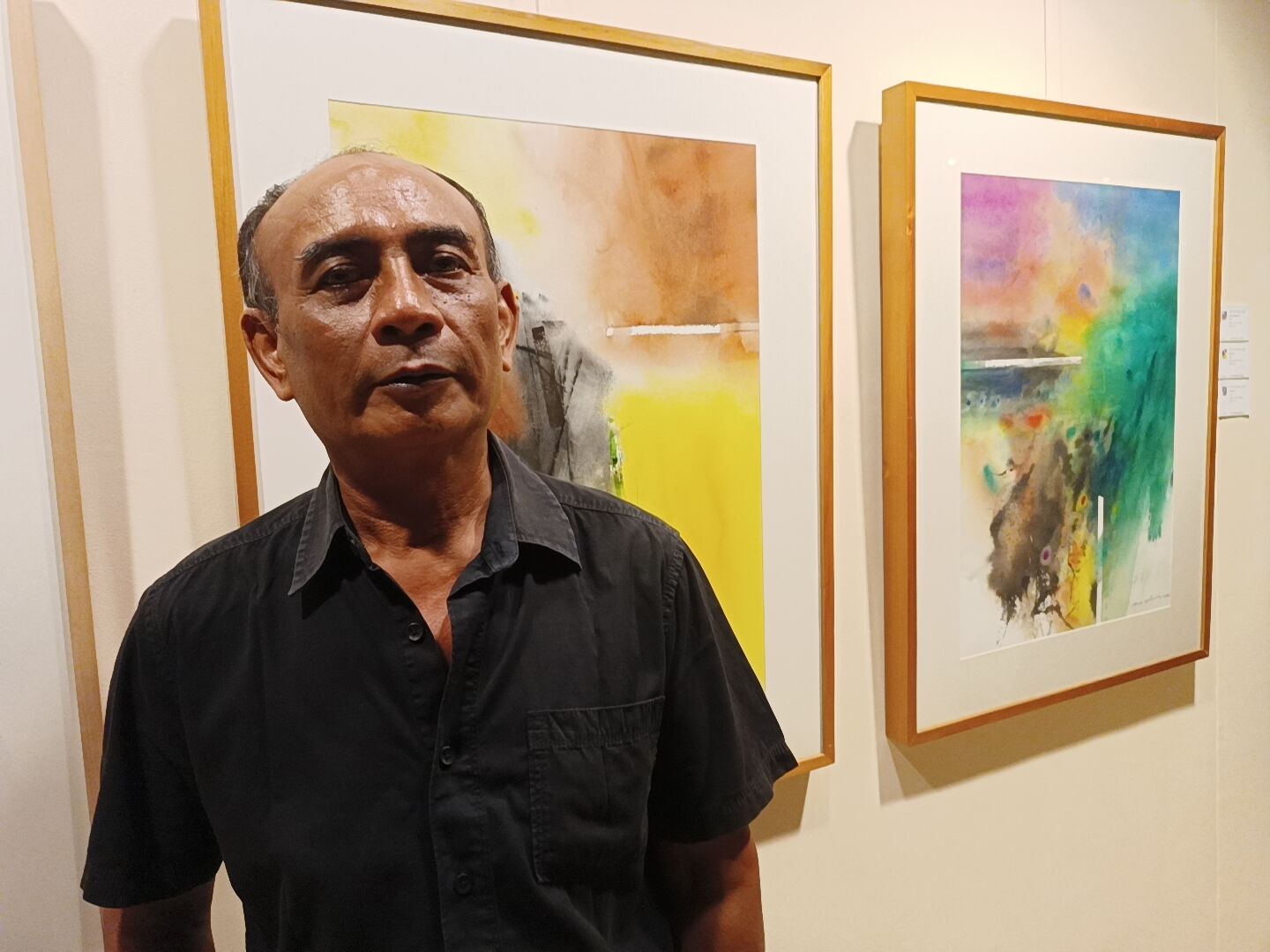
GIANYAR, balitourismnow.com – Komaneka Fine Art Gallery in Gianyar is currently presenting a solo exhibition by Balinese artist I Made Mahendra Mangku. Titled What Remains in Water, Time, Silence, and Traces of Emergence, the exhibition features 34 watercolor paintings that explore memory, nature, and the passage of time through an abstract expressionist approach.
Opened on June 20, 2026, the exhibition runs through July 20, 2026, showcasing a series of large-scale works that demonstrate the expressive and contemporary possibilities of watercolor as a medium.
The opening was attended by Komaneka Gallery owner Pande Nyoman Wahyu Suteja, cultural figure Putu Suasta, artist Marlowe Bandem, members of the art community, collectors, and international visitors.
“This is my fourth solo exhibition at Komaneka Gallery,” Mahendra Mangku explained. “The works presented here revolve around memories—my memories of nature itself, its degradation, preservation, and the transformations it undergoes.”
Rather than offering direct representations, the exhibition invites viewers to experience resonances of memory. Fragments of light, atmospheric traces, and subtle recollections emerge through translucent layers of watercolor, creating visual experiences that feel both distant and intimately familiar.
“Through transparent layers, empty spaces, and the encounter between control and chance, I construct a visual language grounded in sensitivity rather than mastery,” said the artist, whose works have been exhibited both nationally and internationally.
The exhibition reflects Mahendra Mangku’s ongoing contemplation of personal and collective memories, developed through moments of silence and reflection. His experiences exhibiting in Yogyakarta, Jakarta, and abroad have significantly shaped his artistic perspective, particularly his relationship with environmental issues.
Many of the works originate from his observations of the changing landscape around him. Among them, two paintings titled Leaning #1 (56 x 78 cm) and Leaning #2 (31 x 41 cm), both created in 2026, hold particular significance.
“In Leaning, I am not trying to criticize land conversion directly,” he explained. “What I express is a sense of fear—the fear that our land is disappearing.”
As a local resident, Mahendra Mangku feels a deep concern about the continuous loss of agricultural and natural spaces. “There is a fear of being displaced from our own homeland,” he admitted.
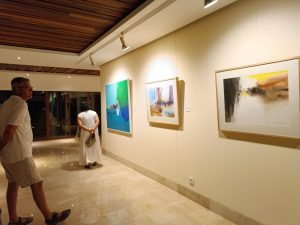
Another notable work, Unraveling, greets visitors near the entrance of the gallery. Dominated by shades of blue, green, and violet, complemented by touches of yellow, red, brown, white, and black, the painting evokes layers of memories floating within a vast sea-like expanse.
Through Unraveling, the artist attempts to sort through experiences and recollections—distinguishing what should be remembered, what should be let go, and what continues to shape his artistic journey, including memories of exhibitions in Yogyakarta, Jakarta, and elsewhere.
Growing Together with Artists and Collectors
According to Komaneka Gallery owner Pande Nyoman Wahyu Suteja, the exhibition reflects the gallery’s long-term commitment to supporting living artists and maintaining meaningful relationships with collectors.
Established in Ubud in 1996, Komaneka expanded its exhibition program with the opening of Komaneka Gallery in 2018. The gallery focuses on contemporary art and actively promotes artists whose practices continue to evolve.
“The artists who exhibit at Komaneka are those with whom I have grown,” Wahyu Suteja explained. “I have known Mahendra Mangku since high school. We have shared ideas and conversations for many years, which is why this is already his fourth exhibition here.”
For Wahyu Suteja, building a relationship with an artist requires time—not only understanding the artwork itself, but also the artist’s creative process and way of thinking.
“We nurture our relationships with artists just as carefully as we nurture our relationships with collectors. Many collectors have grown alongside the gallery, and I continually keep them informed about the artists’ development. That ongoing dialogue between artists, collectors, and the gallery is essential,” he concluded. [buda]