

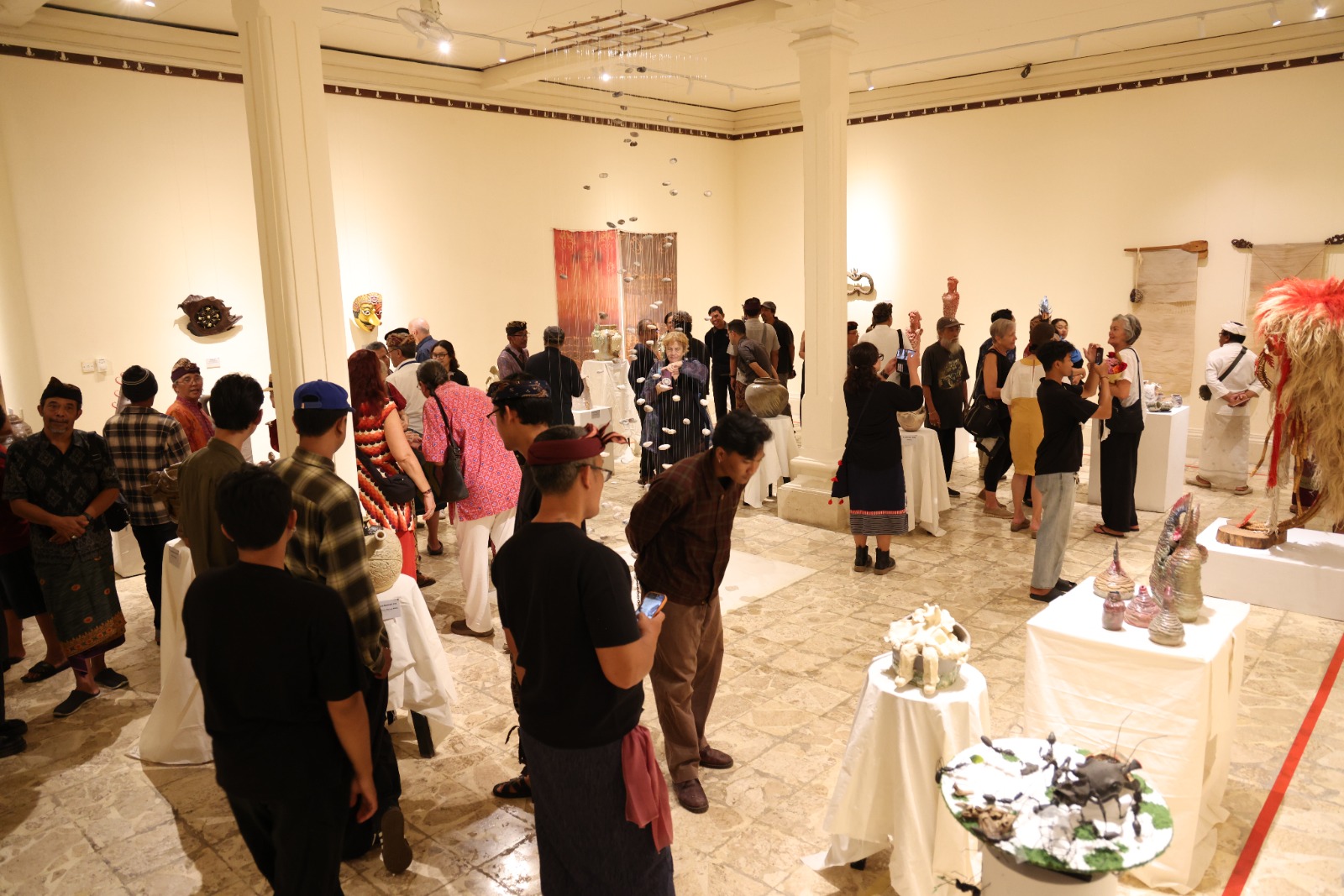
GIANYAR, balitourismnow.com – The art exhibition “Prakriti–Pustaka–Padma 2026” at ARMA Museum, Ubud, offers a rich platform for appreciating the diversity of artistic media, ideas, and creative approaches.
Featuring a combination of two-dimensional and three-dimensional works, the exhibition creates a dynamic atmosphere that brings together the grandeur of sculpture and ceramics, the elegance of batik and traditional textiles, and contemporary explorations of color and form.
Officially opened on 5 July 2026 by Prof. Dr. Kun Adnyana, Rector of the Indonesian Institute of the Arts (ISI) Bali, the exhibition is part of the ARMA Museum’s 30th anniversary celebration.
The opening ceremony was attended by ARMA Museum Founder Anak Agung Rai, alongside curators Jean Couteau, Warih Wisatsana, and Seriyoga Parta. The exhibition will run until 18 July 2026.
The opening ceremony welcomed numerous distinguished guests, including representatives from the Gianyar Department of Culture, the Deans and faculty members of the Faculty of Fine Arts and Design (FSRD) and the Faculty of Performing Arts (FSP) of ISI Bali, cultural figures, artists, renowned Balinese art masters, museum and gallery owners, ISI Bali professors, and participating artists from both Indonesia and abroad.
The opening was enlivened by the performance art piece “Safeguarding What Is Almost Submerged”, created in response to the installation artwork Boat at the End of the Season, which symbolizes the Earth in a state of environmental crisis.
The performers’ bodies represented humanity suspended between guilt, fear, and hope for the future of the planet. Their interaction with the boat structure created a powerful metaphor for the interdependent relationship between humans and nature.
Chairman of the Organizing Committee, Prof. Dr. Drs. I Wayan Suardana, M.Sn., explained that the Prakriti–Pustaka–Padma Craft Exhibition forms part of the ARMA Museum’s 30th anniversary celebration, commemorated on 9 June 2026.
“ARMA Museum is fully committed to presenting a wide range of programs, encompassing not only visual arts but also performing arts at the local, national, and international levels,” he said.
For this year’s exhibition, ARMA Museum collaborated with the Craft Study Program of ISI Bali as the principal organizer of the international exhibition. Presenting diverse artistic media and approaches, the exhibition demonstrates how contemporary craft has evolved rapidly through creativity that transcends geographical and disciplinary boundaries.
The exhibition also serves as a space for contemporary aesthetic exploration, fostered by cross-cultural interactions that continuously enrich artistic possibilities. This international exhibition features artists from eight countries: the United States, the Netherlands, Germany, Switzerland, India, Kenya, Iran, and Indonesia.
In addition to professional artists, the exhibition is supported by craft academics and lecturers from various Indonesian higher education institutions, including ISI Yogyakarta, ISI Surakarta, ISBI Bandung, Universitas Negeri Surabaya (UNESA), the Indonesia Institute of Informatics and Business (IKADO) Surabaya, Muhammadiyah University Bandung, Gorontalo State University, Bumigora University of West Nusa Tenggara, as well as artist collectives from Surabaya.
Overall, Prakriti–Pustaka–Padma features 50 artists presenting a total of 79 two-dimensional and three-dimensional artworks. The exhibition includes 28 ceramic sculptures, 6 terracotta works, 9 ceramic vessels, 4 metal craft pieces, 3 traditional keris, 6 textile works, 3 artistic batik pieces, 2 woodcraft works, 4 tapestries, 6 mixed-media works, 1 leather shadow puppet (wayang kulit), and 4 installation artworks.
“In addition to professional artists, the exhibition also involves academics and craft lecturers from various art institutions across Indonesia, making it a meeting point for artistic practice, education, and cross-cultural exchange of ideas,” he added.
In their curatorial statement, Jean Couteau, Warih Wisatsana, and Seriyoga Parta emphasize that Prakriti–Pustaka–Padma seeks to bring together diverse creative experiences, material explorations, and knowledge systems that underpin contemporary craft practices.
The exhibition demonstrates that craft has evolved beyond traditional disciplinary boundaries, opening a space for dialogue between tradition and innovation through cross-cultural interaction. The exhibition theme is articulated through three key concepts.
Prakriti represents nature as both the source of life and the wellspring of artistic inspiration. Nature is not merely a backdrop but an inseparable part of the creative process.
Pustaka emphasizes that every artwork emerges from accumulated knowledge passed down through generations. This knowledge is embodied in craftsmanship, artistic experience, material experimentation, and traditions that continue to evolve.
Meanwhile, Padma, or the lotus flower, serves as a metaphor for the creative process itself. Just as the lotus rises from the mud to bloom beautifully, every work of art is born through a long journey marked by exploration, failure, transformation, and discovery. Beauty is understood not as an instant achievement, but as the outcome of an ongoing creative journey. [buda]