

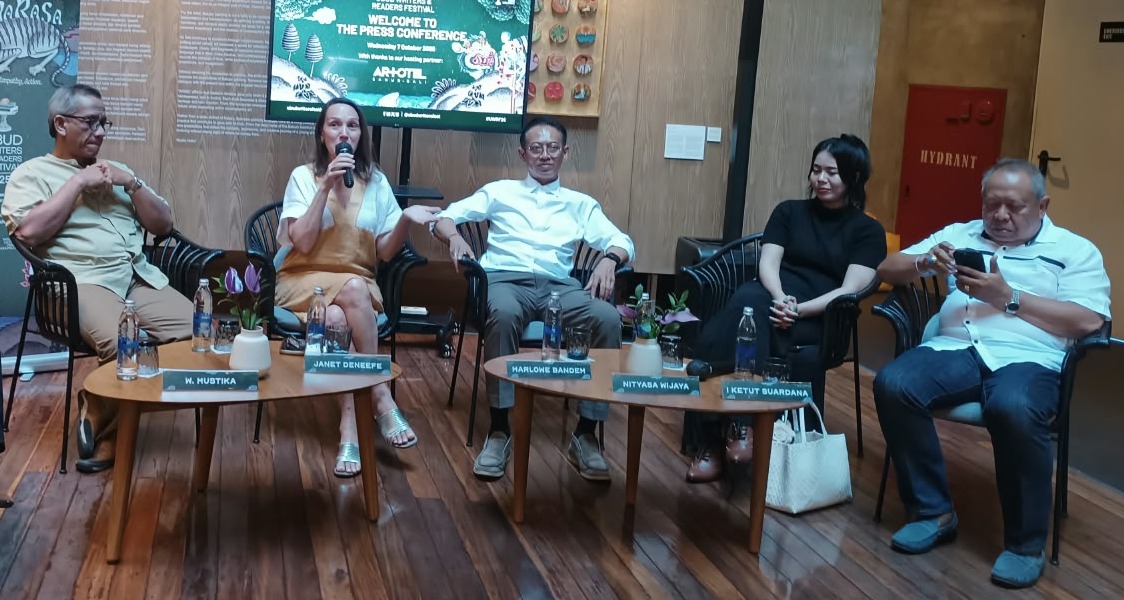
DENPASAR, balitourismnow.com – The Ubud Writers & Readers Festival (UWRF) is more than just an annual routine; it is an event born as a space for healing, cross-cultural dialogue, and a celebration of words and ideas to weave community back together. Entering its 23rd year, UWRF presents the theme Samarasā: Awareness, Empathy, Action, hosting over 200 programs across five days from October 21–25, 2026, in its long-standing home of Ubud.
“Rooted in Sanskrit, Samarasā refers to the idea of balance and harmony. This concept is translated through three core ideas: Awareness, Empathy, and Action,” said I Ketut Suardana, Founder of the Mudra Swari Saraswati Foundation, during a press conference at Artotel Sanur on Wednesday, October 7, 2026.
Elaborating on the meaning of Samarasā and its relevance to Balinese life, Suardana explained that these three pillars invite us not only to understand the world around us, but also to open ourselves to others’ experiences and translate that understanding into action.
“As a concept emphasizing harmony, Samarasā can be seen not just as a philosophical idea, but as something present in how people relate to themselves, each other, the environment, and daily life. We should remember the importance of mindfulness in community living, particularly here in Bali,” he said.
For over two decades, UWRF has served as a meeting place for diverse voices from Indonesia and around the globe. “This year, UWRF will bring together writers, readers, artists, thinkers, and cultural advocates from Indonesia and across the world in programs exploring how stories build awareness, expand empathy, and inspire action,” Suardana added.
UWRF Founder and Director Janet DeNeefe noted that the festival was founded in the wake of the Bali bombings as an effort to help the community heal and gradually move forward.
“The spirit of bringing people together, creating space for conversation, and rebuilding a sense of togetherness continues to drive this festival today. Each year, we address issues that concern us all, because I believe that by talking and listening to one another, we can begin to understand each other,” she explained.
Through literary events and cross-cultural discussions, UWRF continuously offers room to share experiences and hear different perspectives. In an increasingly complex world, dedicated spaces to meet, converse, and listen have become more vital than ever.
DeNeefe added that in a world predominantly navigated through screens, the opportunity to gather and listen in person is invaluable. People may not always agree on every point, but true listening allows for a deeper understanding of how others view the world.
“I believe UWRF can serve as a space to rediscover that common ground—a place where we meet as human beings, share stories, and perhaps leave with a slightly altered perspective. For me, that is what keeps this festival moving forward,” she said.
Wayan Mustika, an academic, author, and practitioner of Nusantara spirituality, further expanded on Samarasā. Through citta (mind) and rasa (feeling/intuition), writers can create works that foster peace. Shared feeling gives rise to empathy, and empathy teaches us not to harm one another.
“That is the core meaning of Samarasā that I believe is essential to embody in daily life—how we treat nature, fellow human beings, and whichever path in life we choose with the same level of care. From there, we can build peace and make the world a better place for everyone,” he explained.
At this year’s festival, Mustika will host Walking the Sacred Cycle, a guided journey to two key temples in Ubud that introduces participants to Balinese life traditions. Attendees will learn about the Kanda Pat concept while visiting Pura Dalem and Pura Prajapati to observe how Balinese society understands the connection between life and death.
Mustika will also join the panel session Life and Death at Intersections, which explores how life and death are interpreted through the lenses of science, culture, and spirituality.
Indonesian creative practitioner Marlowe Bandem highlighted that Awareness, Empathy, Action is also closely connected to how people understand history and cultural heritage. He brings this perspective through his work with the Bali 1928 Archives, an initiative dedicated to preserving, restoring, and reintroducing Bali’s historical archives to the public.
“To me, the most important thing young people can do is dare to ask questions. Amid rapid technological change, they need to revisit what they inherit, understand traditional knowledge, and critically question the ethics and direction of change. This includes having the courage to address painful and uncomfortable truths, because questioning is how we shape our future,” he stated.
Bandem will also participate in the session Burning Books, Accepting Artifice: Man or Machine?, addressing the impact of artificial intelligence on knowledge, critical thinking, and human understanding of the world.
Representing the younger generation, Nityasa Wijaya, one of the UWRF 2026 Emerging Writers, views the festival as an opportunity to connect with readers, writers, and broader communities while developing her voice as an author.
“For me, UWRF is not just a platform to present work, but a space to find friends, build networks, and engage with writers across generations. Having my work, Perempuan Buah Langit—which addresses women’s perspectives in a patriarchal society—selected for the bilingual anthology allows a woman’s voice to reach a wider audience,” Wijaya shared.
Her participation in the Emerging Writers Programme aligns with the festival’s commitment to nurturing new talent in Indonesia’s literary ecosystem. Musician Baskara Putra will also feature in Soundtrack of a Generation, discussing his musical journey with .Feast, his solo project Hindia, and how his lyrics and contemporary observations reflect the voice of a generation.
In the Festival Club series, legendary children’s author Djokolelono will share stories in Childhood Magic: Tales with Djokolelono, while Gus Bao and Ni Wayan Prima will examine the strength of Balinese oral traditions in Bali’s Storytelling Movement.
The festival will also host a free exhibition titled Samarasā: Awareness. Empathy. Action. at Indus Restaurant from October 11–26, 2026. In the panel Is Indonesia Eating Its Own?, Indah G, Tari Lang, and Todung Mulya Lubis will discuss freedom of expression, civic space, and the role of writers when confronting power, moderated by Krishna Sen.
Alongside core programming, UWRF features hundreds of free activities, including Festival Club events at Casa Luna and 49 book launches. Evening programming will offer film screenings, theater performances, poetry readings, and more.
Other notable Balinese speakers and contributors joining this year’s lineup include Prof. I Nyoman Darma Putra, Ni Nyoman Ayu Suciartini, Agung Wardana, Oka Rusmini, Tan Lioe Ie, and Kadek Sonia Piscayanti. [buda]