

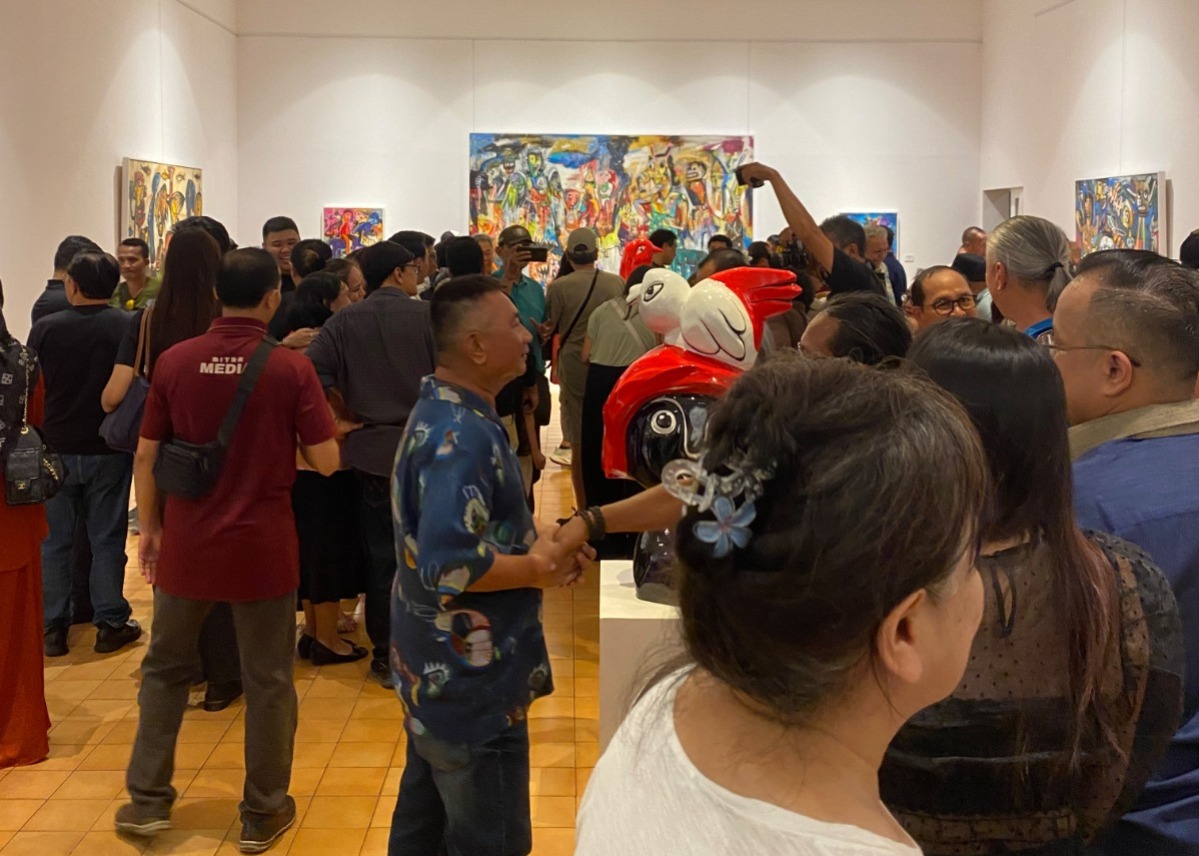
SANUR, balitourismnow.com – The figures on display at Santrian Art Gallery in Sanur on Friday evening, November 6, 2026, appear wild, devoid of perspective, and almost naïve. Yet every element emerges purely from the artist’s intuition. It is within this space that Handy Saputra’s solo exhibition, The Dialog Between The Moon and Its Halo, opened, featuring 25 works comprising 23 paintings and two sculptures. The exhibition runs until December 31, 2026.
The title is borrowed from an ancient poem by Chinese poet Gu Feng, about the moon asking why a halo always remains faithfully by its side. The halo replies that it exists to protect the moon’s subtle beauty.
Handy interprets the poem as a conversation.
“It’s a dialogue between the moon and its halo, a communication between the brightly shining moon and the one that protects it. It’s a symbiosis, about how we seek balance between the macrocosm and the microcosm,” he explained.
This is Handy’s third solo exhibition. His first was held at Rumah Sanur in 2020, followed by a second at Sika Gallery in Ubud in 2025. Handy says the current exhibition reflects the evolution of his creative process.
“Please enjoy the works and interpret them in whatever way you wish. This is the honesty of my work,” he said.
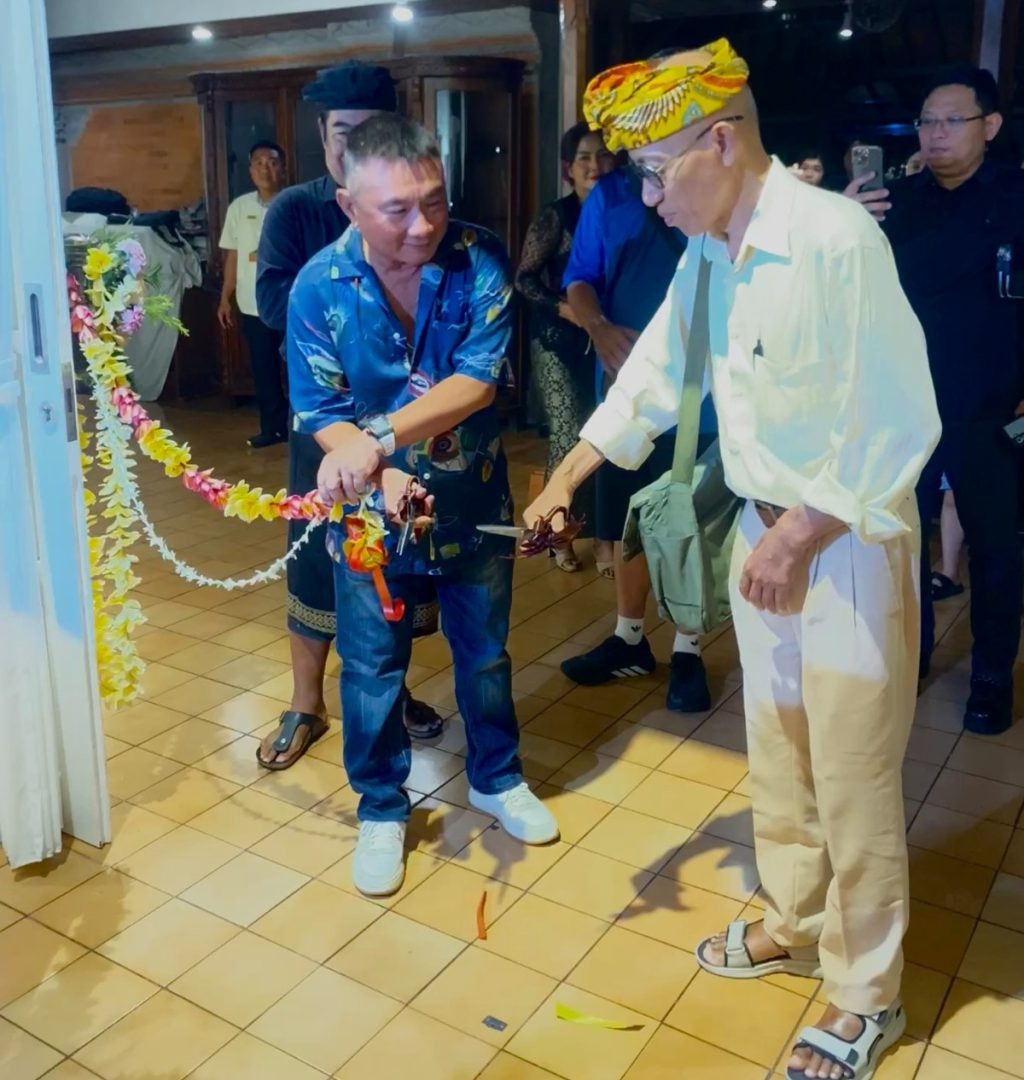
What sets this exhibition apart is its artistic movement. Handy’s works are classified as Art Brut, or raw art, a distinction that curator Muhammad Bundhowi describes as something outside conventional artistic practices.
“Mr. Handy’s works fall into the category of Art Brut, or art that exists outside the established conventions of Bali’s art scene. It is a form of visual art regarded as different from other forms of art. That is what makes Mr. Handy’s work unique and unusual,” Bundhowi said.
According to him, the term was coined by French artist and philosopher Jean Dubuffet to describe art that challenged established conventions in France during the 1940s. In Bali and Indonesia, the movement is not entirely new. However, Bundhowi believes Handy’s work occupies a distinctive place within it.
“Mr. Handy’s Art Brut works are wild and brutal, seemingly naïve, with no perspective or conventional structure. They are truly the product of his intuition,” he said.
Handy is a Bali-born entrepreneur who taught himself to paint. Bundhowi considers his work closer to Neo-Expressionism, although some pieces lean towards abstraction. His palette is dominated by primary rather than secondary colors, reflecting what Bundhowi describes as the honest, unpretentious nature of Art Brut, much like the spontaneous expression of children.
That intuition is immediately apparent on the canvas. Faces and creatures overlap, leaving almost no empty space, framed by thick black outlines. In All Creatures Speak the Same Language – Praise, humans, animals, and imaginary beings coexist without hierarchy. In Welcoming an Angel, the arrival of an angel sparks a commotion reminiscent of a carnival. Real Clown presents a crowd of anxious, screaming faces, which the exhibition catalogue interprets as a reflection of how society itself has become the clown.
Not every work is equally chaotic. A Memoir (110 x 200 cm) is rendered in black and white, with the Japanese kanji for “Kamikaze” appearing among ghost-like faces. In contrast, My Beautiful Day depicts a woman resting peacefully amid cats in cool hues. His two sculptures, The Vigil of the Crimson Spirit and The Weigh of the Bird, feature birds perched atop human heads, presenting an image of freedom that somehow feels burdened.
Colors That Grow Ever Brighter
Since his first exhibition, Handy says, his subject matter has remained consistent: abstract, mystical, and formless figures. What has changed is his choice of medium. His first exhibition featured more works on paper, while the following two saw greater exploration of acrylic.
His use of color has also evolved. Handy recalls frequently hearing observations from friends who have followed his artistic journey.
“The first exhibition tended to be darker, the second somewhat brighter, and the third much brighter. I don’t really see it that way myself, but that’s what those who have followed my work have told me,” he said.
Handy does not feel bound by artistic conventions.
“I work without rules, and I don’t even have a concept,” he said.
He approaches a blank canvas without a plan. For example, when he sees a horse, he begins by drawing a horse. As the sketch develops, it may start to resemble some strange creature, and he simply continues from there.
“You could call it spontaneity,” he said.
As for interpretation, he leaves that entirely to the audience.
“I leave the objective truth of the work to the viewers. What I can offer is the honesty of my works, just as they are,” Handy explained.
Reading Between the Lines
Bundhowi encourages visitors to look beyond what is immediately visible.
“We cannot look at Mr. Handy’s work solely from its outward appearance or what is explicitly presented. We must also consider what lies beneath the surface,” he said.
He suggests that viewers should “take flight” and observe human behavior through the light of the moon, as the works also tell stories about society and everyday life.
He also discovers unexpected layers of cultural meaning in the paintings. After comparing Handy’s latest works with classical Balinese paintings from the Batuan and Keliki styles, Bundhowi identified numerous images containing cultural values such as Tri Hita Karana.
“Even though Mr. Handy may not have been consciously aware of it when creating these works, those elements are actually there,” he said.
The exhibition is open to visitors at Santrian Art Gallery, Jalan Danau Tamblingan No. 47, Sanur, daily from 9:00 a.m. to 5:00 p.m. Central Indonesia Time (WITA).
In an art world that often evaluates works through technique and established artistic schools, this exhibition invites audiences to consider how raw intuition can also become a way of engaging with oneself and the world—and perhaps, a way of illuminating the events unfolding beneath the surface.