

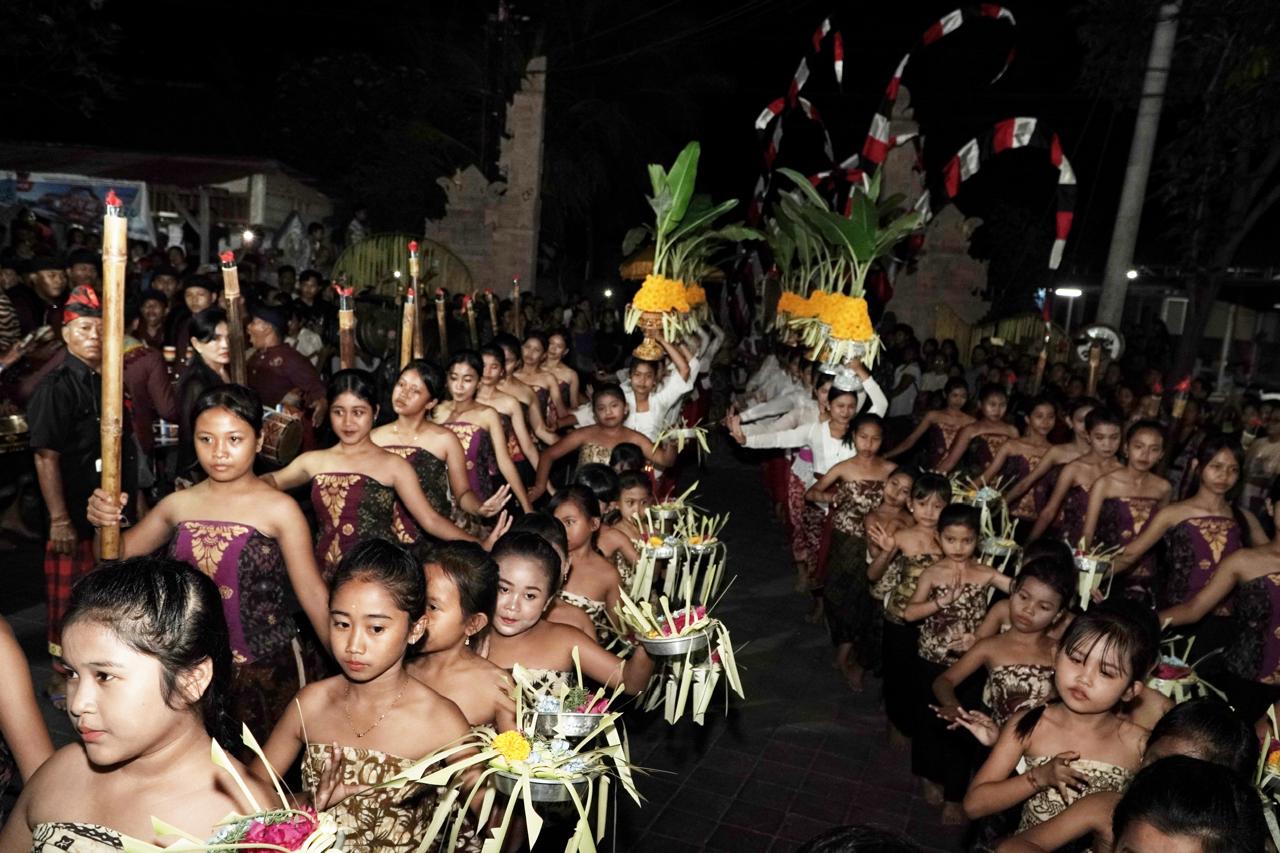
BULELENG, balitourismnow.com – Bali is undeniably known for its diverse and unique cultures. One of them is Megebeg-Gebegan, a unique tradition in Tukadmungga Village, Buleleng District, Bali. It is passed down through generations as a way to ward off evil. It is usually performed the day before Nyepi (Day of Silence).
This tradition was even presented as a cultural tourism theater, posing the result of a research study. The theater, involving 250 children and adolescent dancers, was performed on Wednesday (Jul 23, 2025), in Tukadmungga Village, and witnessed by the local community.
Prof. Dr. Ni Made Ruastiti, a professor of Tourism Performing Arts at the Indonesia Institute of the Arts (ISI) Bali, explained that Megebeg-Gebegan is a ritual offering of a caru godel (calf) as an exorcism ceremony to ward off evil, involving all levels of society.
The arts performance, in collaboration with the Wahyu Semara Shanti Arts Studio, featured a kind of peed aya (parade) procession, consisting of torchbearers, canang sari (basic offerings), gebogan (arrangement of assorted foods and fruits), and rejang dancers and ceremonial bands.
Following the procession, the mecaru (exorcism rite) procession was conducted by Jro Mangku Gusti Aji. The megebeg-gegeban tradition was then performed by four banjars or customary hamlets in Tukadmungga Village.

The four banjars are Banjar Dharma Yasa, Dharma Yadnya, Dharma Semadi, and Dharma Kerti. This tradition was presented in a more aesthetic performance art style and utilized two gamelan ensembles: the gong kebyar mepacek and the baleganjur barungan. The composition was choreographed by Kadek Angga Wahyu Pradana, who is also the Head of the Wahyu Semara Shanti Studio. Women were deliberately highlighted more than men.
Approximately 250 children participated in the performance, with 150 girls as dancers and carriers of the uparengga (a type of torch-like offerings), and 100 boys as gamelan players.
The performance conveyed a powerful and realistic impression that women are the pillars, or even the main engines of culture. The performance also demonstrated the dominant presence and influence of women’s lives.
In addition to the involvement of women in cultural theater performances, represented by children, the adults will receive technological understanding and training, including website management, to support tourism.
Furthermore, language and communication skills will be developed to elevate their status as equal and dignified human beings. “Since we are linking this to tourism, we are trying to empower women to become leaders,” she said.
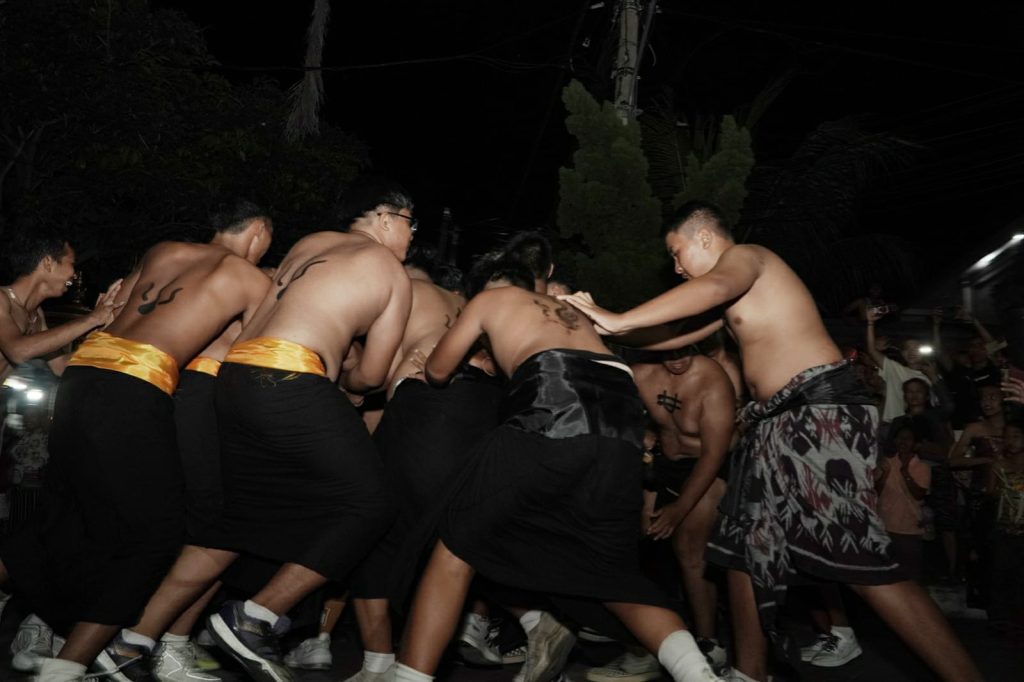
The process of arranging the offerings, caru (exorcism offerings), and the collective struggle for the calf meat are sacred elements that does not only serve spiritual purposes but also strengthen social cohesion. This tradition is currently undergoing a shift in form, from a sacred ritual to a community-based tourism theater.
“I am interested in researching this tradition to connect it with women’s empowerment and performing arts for tourism. The research is entitled “Women’s Empowerment Through the Revitalization of the Megebeg-Gebegan Tradition as Cultural Tourism Theater in North Bali,” she said.
The transformation of the Megebeg-Gebegan tradition into performing arts or theater does not diminish its sacred value. On the contrary, it is strengthened by the active role of women who do not only keep the tradition alive but also reconstruct its narrative to be more communicative, inclusive and adaptive to the times.
Women’s presence in culture is evident in almost every sphere. In religious ceremonies, for example, women are heavily involved, from the production and preparation stages to the closing ceremony. Women are never absent, including in the entertainment realm.
“The presence of women as the main actors is barely mentioned, thus contributing to the impression that women are recognized as significant human beings, only behind the scenes. Women are empowered but not recognized,” said Prof. Ruastiti.
Prof. Ruastiti conducted the research for two years with I Nyoman Kariasa, Arya Pageh Wibawa, Ni Kadek Suryani, and I Wayan Winaja. This performance is a collaboration with Sanggar Wahyu Semara Shanti, as a medium for empowering women through performance.
“I think the village is a worthy research object, culturally and socially, especially regarding women’s involvement in domestic affairs and rituals, which are dominant but rarely mentioned or discussed. It is indeed worthy of being brought to the forefront from a gender perspective,” she explained.
In Tukadmungga Village, Megebeg-Gebegan has become a ritual to ward off evil during the caru godel (calf) offering ceremony. This event is usually held once a year, especially on the eve of Pengerupukan, or the day before Nyepi.
Women play a significant role in this ritual. They do not only design the composition of the gebegan and arrange the offerings, but also extend to training in choreography and narration. “Here, the work of the Family Welfare Empowerment (PKK) women in the ritual is quite complex,” she emphasized.
For example, they lead the matur piuning or notification procession at Khayangan Tiga Temple, while simultaneously bringing the ritual’s spiritual aspects to life through kidung (psalmody) and Dharma Gita chants.
Meanwhile, young women join the performance, carrying the gebogan and offerings, adding to the beauty and harmony of the ritual.
Tourism Performance
In addition to involving adult women in the ceremony, young women are also involved as a symbol of regeneration through their roles in carrying canang (basic offerings).
“From this ‘Megebeg-gebegan performance as Cultural Tourism Theater in North Bali,’ I find this phenomenon to be a concrete example of community in the turnerian sense, where boundaries of hierarchy and age are transcended by solidarity in collective cultural practices,” she said.
This can be felt when women participate in a ritual that transcends age boundaries. This includes allowing the presence of women across generations to contrast the visual beauty with the rich symbolic meaning.
They determine the shape and color of the gebegan, the choice of natural materials for the property, and the spatial arrangement to align with local cosmology. “Properties such as spears and young coconut leaves are not merely visual objects, but also spiritual markers shaped by women’s symbolic narratives,” she explained.
This revitalized performance serves as a kind of replica, allowing local and international visitors to experience it not just once a year, but anytime as a tourist theater performance. Simply visit the village for a cultural outing.
To maintain its sacredness, the Megebeg-Gebegan tradition must be conceptualized differently, reflecting its more recreational (tourism) purpose. However, this does not mean its sacredness is being compromised, as the revitalization of this tradition remains within reasonable limits. [buda]