

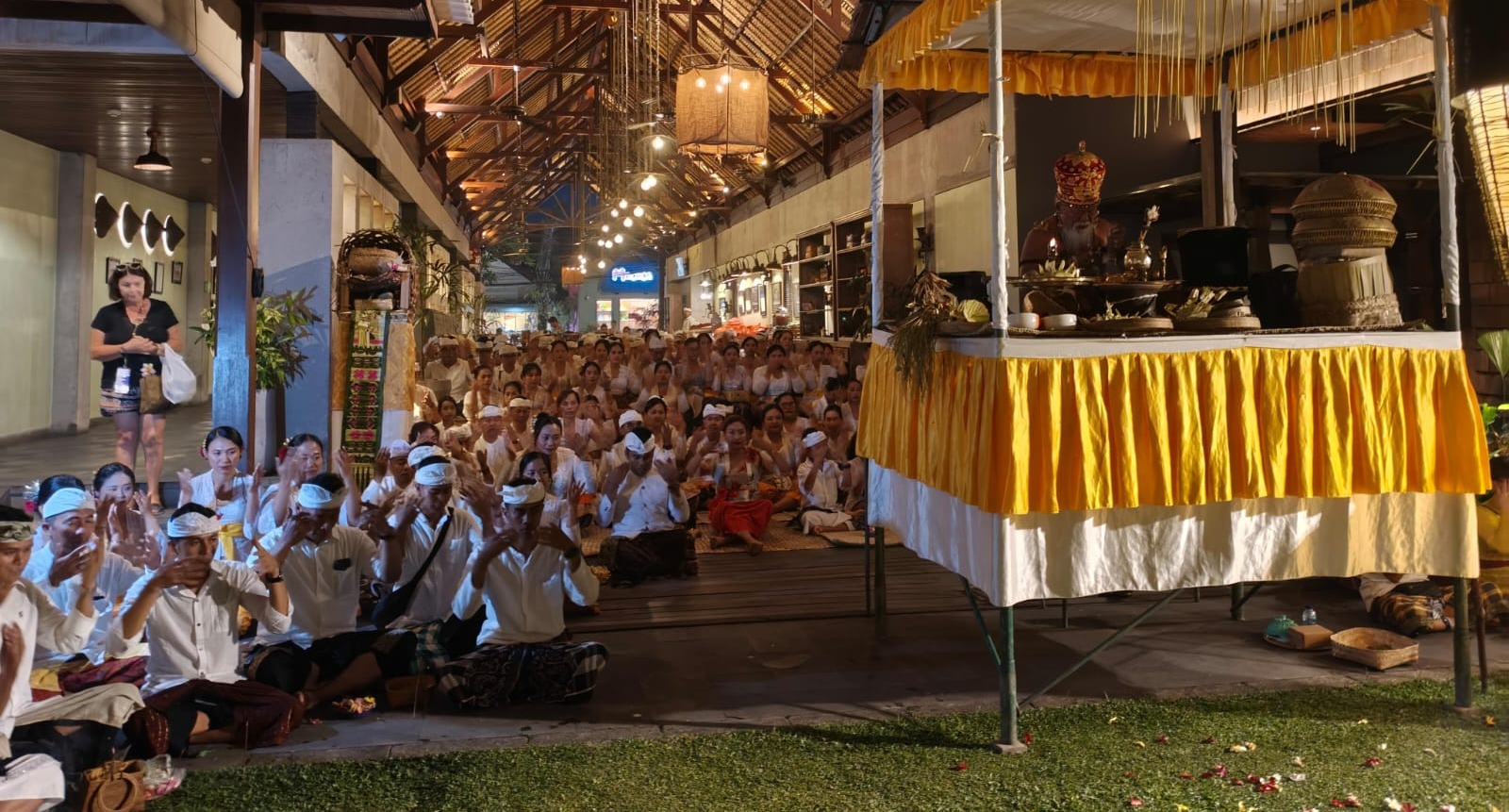
GIANYAR, balitourismnow.com – A solemn yet serene atmosphere enveloped Alaya Resort Ubud on Wednesday, October 7, 2026. Set against a backdrop of lush green rice fields, the resort’s staff, dressed in traditional Balinese attire, gathered with gratitude to observe Piodalan, a sacred ceremony that reflects the resort’s ongoing commitment to honouring Balinese traditions and cultural heritage.
Held at the resort’s Padmasana, the Piodalan ceremony provided a meaningful moment for the Alaya family to offer prayers, express gratitude, and nurture the harmony that lies at the heart of Balinese life.
Rooted in the philosophy of Tri Hita Karana—the Balinese principle of harmony between the divine, nature, and people—Piodalan forms an important part of the cultural life and identity of Alaya Resort Ubud.
“Piodalan is a meaningful moment for our entire team to pause from our daily routines, express our gratitude, and come together to honour a cultural heritage that remains an important part of Balinese life,” said Dewi Mas, Chief Operating Officer of Alaya Hotels & Resorts.
The ceremonial preparations began on October 5 with Nunas Tirta, a ritual to seek holy water, carried out at several temples in the Padang Tegal and central Ubud areas, including Pura Desa and Puseh, Pura Melanting, and Pura Gunung Lebah.

The following day, Alaya Resort Ubud held a series of internal activities involving employee representatives from various departments. Beyond preparing for the ceremony, the activities were designed to strengthen team spirit and encourage employees to take an active role in preserving local traditions.
The initiatives form part of the resort’s ongoing practice of Parahyangan, one of the three principles of Tri Hita Karana, and continue a tradition that has been observed at Alaya Resort Ubud since 2017.
As part of this tradition, each department takes on the role of Pengempon, referring to those entrusted with caring for and maintaining the respective pelinggih, or sacred shrines, within the resort.
Nine pelinggih are located within the Parahyangan area of Alaya Resort Ubud, with each shrine cared for by a designated group of employee representatives serving as its Pengempon.
The activities began with Mereresik, a communal ritual of cleaning and preparing the sacred areas, followed by the Mayasan Pelinggih competition.
Each Pengempon group brought its own creativity to the decoration and arrangement of the pelinggih and palangkiran, incorporating traditional Balinese wastra textiles and ornaments.
The spirit of togetherness continued through a Gebogan arrangement competition, in which employees created traditional offerings using locally sourced fruits and natural materials.
Beyond preparing the sacred spaces for the religious observances, these activities offered employees an opportunity to actively participate in preserving Balinese traditions while strengthening a shared sense of responsibility, teamwork, and community.
A Sacred Celebration of Harmony
The Piodalan ceremony reached its peak on October 7, beginning with Mecaru, a ritual of purification and spiritual harmony, followed by a communal prayer ceremony in the afternoon at the Padmasana.
The management team and employees of Alaya Resort Ubud, together with invited guests, took part in the prayer ceremony dressed in traditional Balinese attire, creating an atmosphere that was both solemn and deeply communal.
One of the meaningful elements of the Piodalan ceremony was Rejang Renteng, a sacred dance traditionally performed as part of Hindu religious ceremonies.
Performed in a connected formation, the dance reflects togetherness, harmony, and sincere devotion in making an offering to Ida Sang Hyang Widhi Wasa. Within the ceremony, the dance serves as an offering and a gesture of respect for the presence of Ida Bhatara.
At Alaya Resort Ubud, the dance carried particular significance as it was performed by the resort’s own employees, allowing them to take part directly in the sacred offering and become an integral part of the Piodalan celebration.
Sharing Balinese Culture with Guests
As part of its commitment to delivering an authentic Indonesian hospitality experience in Bali, Alaya Resort Ubud also welcomed in-house guests from Alaya properties to witness and experience the cultural occasion firsthand.
Their participation provided an opportunity to gain a closer understanding of Balinese traditions while respecting the values, customs, and cultural context surrounding the ceremony.
“For Alaya, culture is not simply an experience we present to our guests, but a value that we embrace in our everyday life. Through Piodalan, we continue to nurture our relationship with God, our surrounding environment, and our community, while creating an opportunity for our guests to experience the warmth of Balinese culture more closely,” said Dewi Mas.
Rooted in Ubud, one of Bali’s renowned centres of art and culture, Alaya Resort Ubud continues to embrace local culture as an integral part of its hospitality experience.
Through its annual Piodalan ceremony and initiatives rooted in local traditions, the resort seeks to keep Balinese heritage alive within its everyday environment while creating meaningful opportunities for both employees and guests to connect with the island’s cultural identity.
For Alaya Resort Ubud, Piodalan is more than an annual religious observance. It is a reflection of a living tradition—one that brings people together, strengthens a sense of community, and keeps the values of Balinese culture connected to contemporary hospitality.