

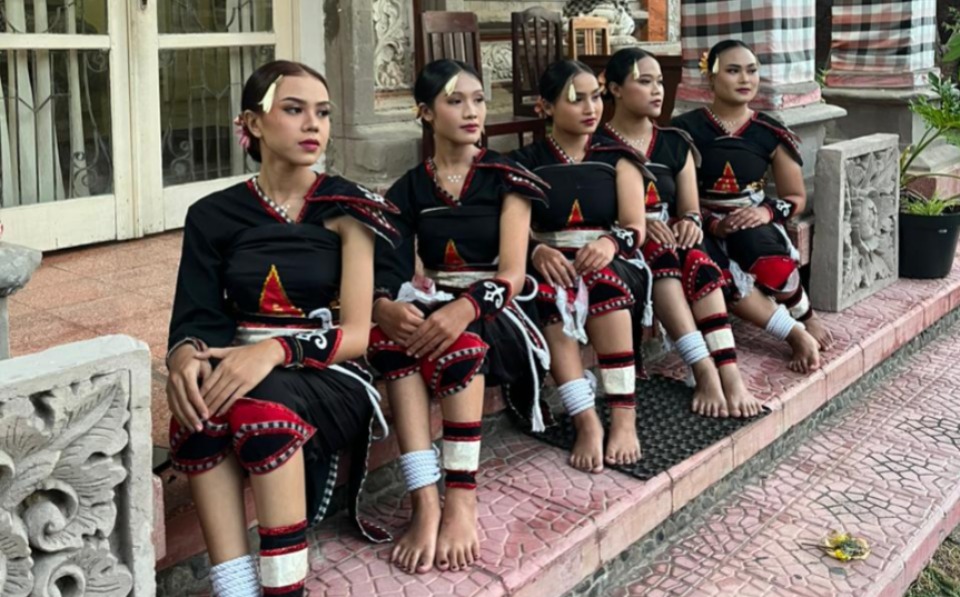
SINGARAJA, balitourismnow.com – The opening of the Singaraja Literary Festival (SLF) 2026 began with a contemporary dance performance titled Perempuan di Sawah (Women in the Rice Fields). Rather than being staged on the main platform, the performance took place among the audience at the entrance to the historic venue where the festival was held.
Presented by the Lemah Tulis Community, the dance served as a welcoming performance that emphasized symbolic movement over visual spectacle. Instead of focusing on aesthetic beauty, it used body language as a symbolic medium to convey ideas, emotions, and social criticism.
“Perempuan di Sawah is actually an adapted and condensed version of our 2024 production by Teater , titled Prakertaning Dharma Pemaculan, revised to align with the theme of SLF 2026,” said choreographer Putu Bratria Dama Dayanu after the performance on Friday, July 3, 2026.
Performed by five dancers, the work explored the relationship between women and traditional rice farming, presenting an agrarian narrative that highlights women’s resilience in sustaining food security, preserving agricultural cycles, and bridging rural life with modernity.
Although the costumes appeared simple, they effectively reinforced the atmosphere and communicated meaning through symbolic elements. The choreography combined the everyday movements of farmers with freer, more dynamic contemporary expressions, emphasizing the importance of honoring rice fields as spaces that sustain life.
“Amid rapid development, many agricultural activities are gradually disappearing, while Bali’s rice fields continue to face numerous challenges that threaten their sustainability,” Putu Bratria explained.
Despite its contemporary approach, the dance remained firmly rooted in Bali’s farming traditions, emphasizing symbolic movement and the deep relationship between humans and nature.
The performance unfolded in four sections. In the opening scene, the five dancers carried traditional water jars as symbols of Mapag Toya, a ritual performed to welcome water before preparing rice fields for cultivation. The simple act of collecting water symbolized its essential role as the source of life and the foundation of Bali’s irrigation system.
“Mapag Toya symbolizes that water is the most vital element in irrigating rice fields,” he said.
The second section focused on expressive hand movements—opening and closing the palms—as symbols of Jyotisa, the traditional knowledge of astrology. This sequence portrayed how Balinese farmers once relied on the positions of the stars and the Wariga calendar to determine the most favorable times for planting rice and other crops.
According to Putu Bratria, traditional farmers did not rely solely on intuition. Although they did not use modern calendars, they carefully observed Wariga, astrology, auspicious days, and seasonal conditions, believing these factors influenced crop growth and harvests.
The third section illustrated everyday farming activities, including planting rice, tilling the soil, and driving birds away from the fields. These agricultural processes were expressed through a dynamic sequence of movements representing the daily lives of farmers.
The final section served as the climax of the performance, focusing on the sanctity of rice fields.
“In this section, we once again reinterpret the Sang Hyang Dedari dance as a symbol that nature also communicates its messages through human beings,” Putu Bratria said.
The production is a condensed adaptation of the group’s 2024 work, streamlined in both cast size and narrative to suit this year’s Singaraja Literary Festival.
Lasting approximately ten minutes, the performance featured electronic music blended with traditional Balinese sounds. The dancers wore costumes dominated by red, black, and white—the colors of Tridatu—which also represented the philosophical values of Tri Hita Karana.
“Although the dance centers on rice fields, the concept of Tri Hita Karana remains at its core. Palemahan is reflected in humanity’s relationship with the land, Pawongan in the spirit of cooperation among people, and Parahyangan in the tradition of beginning every farming season with ceremonial offerings,” Putu Bratria Dama Dayanu concluded.