

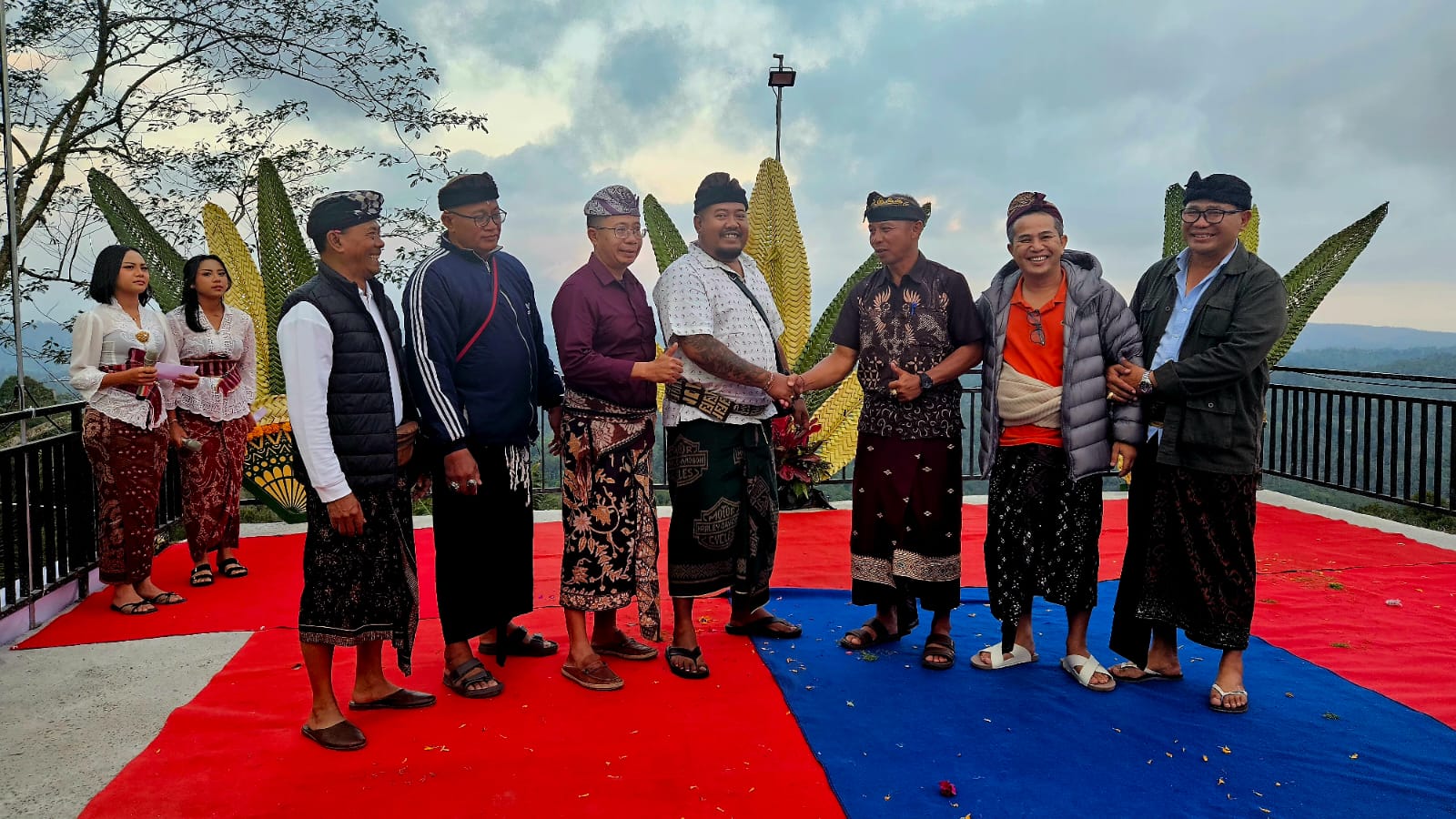
BULELENG, balitourismnow.com – The movements may not have been perfect, but the emotions behind them ran deep. As flowers were scattered in a traditional gesture of welcome, what emerged was more than a dance. It was an expression of pride, joy and devotion to the village they call home.
Accompanied by the dynamic sounds of Balinese gamelan, the dancers moved through graceful seledet eye movements and changing formations, creating a lively sequence that seemed to embody the spirit of menyama braya—the Balinese philosophy of togetherness and communal solidarity.
This atmosphere marked the launch of the Tista Traditional Village Anjungan in Dapdap Putih Village, Busungbiu District, Buleleng Regency, on Saturday, September 5, 2026. The new pavilion is expected to become a gateway for developing village-based tourism while showcasing the natural and cultural wealth of Bali’s northern highlands.
Located along the strategic Pekutatan–Dapdap Putih–Pupuan route, the pavilion overlooks rolling hills, valleys and expansive plantations. The surrounding area remains relatively untouched, offering visitors a glimpse of rural Bali away from the island’s more established tourist destinations.
The area also holds several tourism attractions, including trekking routes and spiritual experiences such as penglukatan, a traditional Balinese purification ritual. Its natural landscape and living cultural traditions provide a strong foundation for developing a more community-oriented tourism experience.
Yet, the pavilion represents more than a new physical facility. It is also a symbol of solidarity and the commitment of Putra Desa Adat Tista—members of the village community living outside the area—to contribute to the development of their ancestral home.
“The development of the pavilion is a tangible form of concern from Putra Desa in taking part in building the traditional village. Through this spirit of togetherness, we hope Putra Desa can continue to help ease the responsibilities of the customary community, contribute ideas for the village’s progress, and create activities that benefit the wider community,” said I Gede Supariatna, Chairman of Putra Desa Adat Tista, accompanied by advisors Jro De Belong and Komang Galung.
For the people of Tista, the project demonstrates how village development can grow from within the community itself. Those living away from home can still contribute their ideas, resources and energy to the place where their roots remain.
Planting 1,000 Cemara Lilin Trees
The commitment to developing Tista does not end with the completion of the pavilion. Putra Desa Adat Tista has also launched the Green Movement, with a target of gradually planting 1,000 cemara lilin trees along roads and at strategic points throughout the village.
Komang Edyanto, better known as Mang Galung, an advisor to Putra Desa Adat Tista, said the initiative is intended to create a greener identity for the village while strengthening its tourism appeal.
“Planting cemara lilin trees is not only about greening the area, but is also expected to become an icon of Tista Village. Village tourism development must be supported by community awareness so that it can create new economic opportunities,” he said.
The initiative is envisioned as more than an environmental program. As the trees grow, they are expected to contribute to a distinctive landscape that can become part of the visual identity of Tista.
Mang Galung believes the upper Busungbiu area has considerable potential for tourism development, supported by its natural environment, cultural heritage and traditional community activities that remain well preserved.
Connecting Nature, Culture and Local Economy
Jro Kadek Asoi, Bendesa Adat Tista, welcomed the initiative and expressed his appreciation for the role played by Putra Desa in developing the Anjungan as part of the village’s tourism potential.
“The purpose of this development is to highlight the tourism potential of the upper Busungbiu area. There are many opportunities that can be developed, ranging from sacred water sources or beji, trekking routes with views of hills and plantations, to the diverse potential of the five traditional villages in this area,” he explained.
The strength of Tista lies not only in its scenery, but also in the relationship between nature, culture and everyday community life. This provides an opportunity to develop tourism without losing the character and identity of the village.
I Gede Marjaya, Head of Dapdap Putih Village, also praised the initiative, describing it as an example of how the younger generation can play an active role in developing their ancestral village.
“I feel proud of the ideas and efforts to empower the potential driven by the younger generation of Tista Traditional Village. This can serve as an example for young people from other traditional villages to contribute to the development of their hometowns,” he said.
According to Marjaya, the five villages in the upper Busungbiu area possess remarkable natural potential that should be developed sustainably. The Tista Traditional Village Pavilion, therefore, is expected to become more than simply a stopover.
It could evolve into a shared space where visitors can discover the area’s landscapes, traditions, cultural practices and the warmth of the local community.
Such development could also create new opportunities for the local economy through village products, cultural activities, creative initiatives and community-based tourism experiences.
“On behalf of Putra Desa Adat Tista, we would like to express our deepest gratitude and appreciation to all customary community members, krama pengampel, elders, village officials, donors, and everyone who has supported us in making the Tista Traditional Village Anjungan a reality,” said Jro De Belong.
With the completion of the pavilion, Tista has taken a new step toward shaping its tourism future. What stands today may be a simple pavilion along a rural road, but its meaning goes much deeper.
It represents a community coming together to care for its homeland, protect its natural and cultural heritage, and create new opportunities for future generations.
In Tista, tourism is not simply about attracting visitors. It is about allowing nature, culture and community to grow together—while keeping the village’s identity firmly rooted in its own soil.