

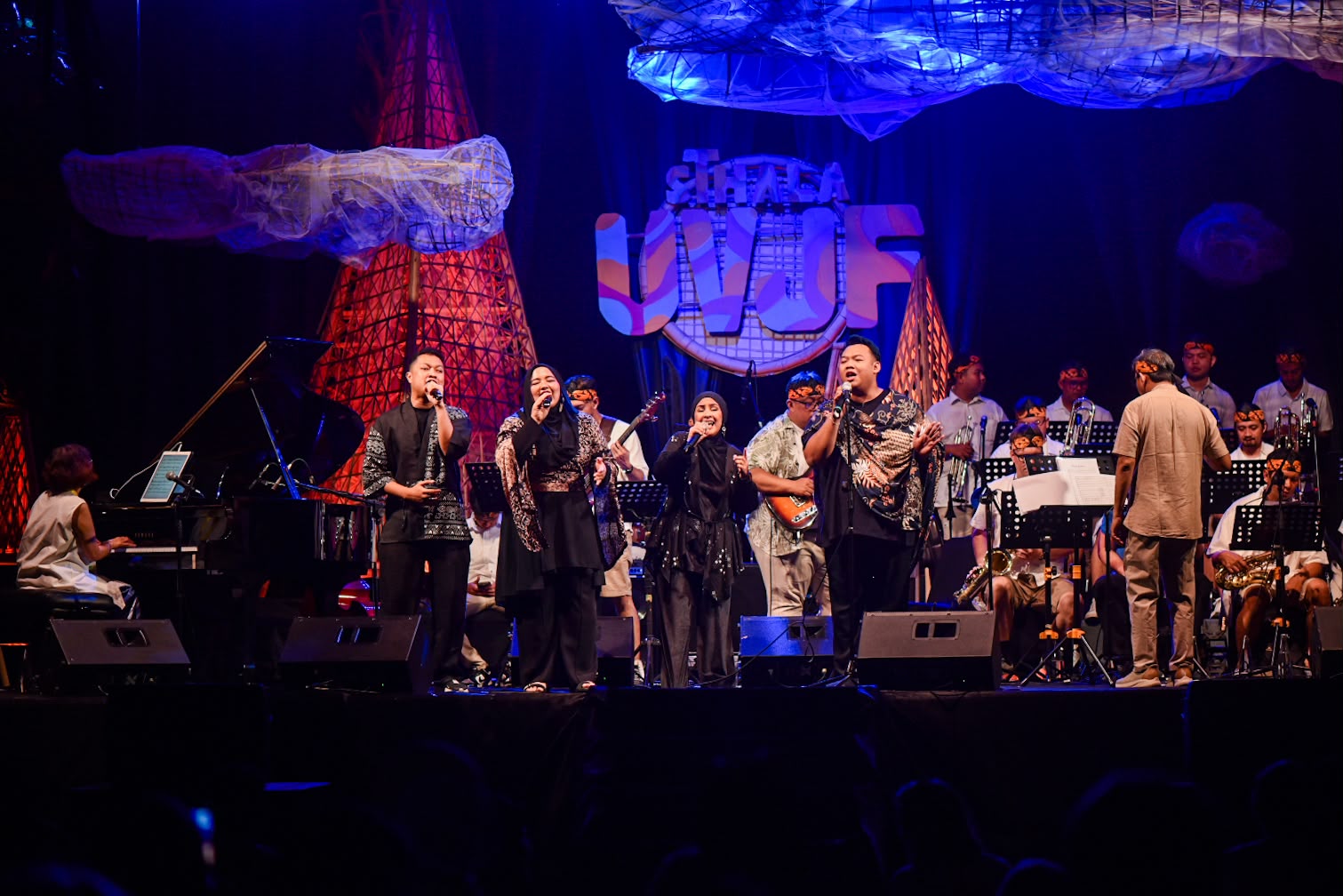
UBUD, balitourismnow.com — The Sthala Ubud Village Jazz Festival (UVJF) 2026 officially opened on Friday evening, August 7, at STHALA Ubud Bali, A Tribute Portfolio Hotel, welcoming audiences to two days of music, art, and creative experiences as the festival celebrates its 13th edition.
A brief opening ceremony was held at the Giri Stage from 6:05 to 6:20 p.m., followed by an energetic performance by Salamander Big Band, an independent jazz orchestra from Bandung that is celebrating nearly two decades together with a lineup of around 27 musicians.
Earlier in the evening, audiences enjoyed performances by Rason Trio and Imelda Rosalin Quintet. The festival then continued with performances by LaDju, Simone Prattico Java Collective, Dattie Do Duo, Straight & Stretch, and Michael Ananda Trio across the Giri and Subak stages.
The festival unfolds across three interconnected performance spaces: the Giri Stage; the riverside Subak Stage, nestled among banyan trees and natural rock formations; and the Community Stage, where Westside Vinyl DJs keep jazz-inspired selections spinning throughout the afternoon.
Reflecting on the philosophy behind the festival, Heru Djatmiko of the UVJF 2026 Committee said commercial success had never been the festival’s primary motivation.
“We didn’t build this festival to make money. We built it because we love jazz.”
The same spirit was echoed by Lasta Arimbawa, General Manager of STHALA Ubud Bali, who said he was impressed by how creatively the familiar venue had been transformed for this year’s festival.
“The first thing that struck me was the creativity. Same venue. Different setup. That deserves real appreciation.”
Lasta also recalled a moment from the festival’s press conference the previous week, when a journalist asked festival co-founder Yuri Mahatma about the attendance target for this year.
“Yuri simply replied, ‘I don’t care about the numbers. As long as people come and enjoy the music, that’s enough for me.’ To me, that was a powerful statement—just as meaningful as Pak Heru saying this festival wasn’t created to make money, but out of love for jazz. Those two statements tell you everything about what this festival stands for. Ubud Village Jazz Festival is built with heart.”
A First for UVJF: Art from Discarded Materials
One of this year’s most significant additions is the festival’s first-ever visual art exhibition, “Second Life: An Exhibition of Found Materials & Upcycled Art,” curated by the art collective Kala Patha.
The exhibition features works by eight contemporary artists—Ayu Murniati, Defina Sumardji, Ediwe, I Komang Adiartha, Modjo, Nym Handi Ya, Skinner Ohrami, and Sofiya Shukhova—who transform discarded objects, reclaimed materials, and industrial remnants into new artistic forms.
Presented under Kala Patha’s curatorial concept, “Island of Hope,” the exhibition takes visitors on a journey through Bali’s environmental realities before leading them toward a more hopeful vision of the future.
Outside the venue, visitors are first greeted by propaganda-style posters highlighting some of Bali’s most pressing challenges, including overtourism, environmental degradation, mounting waste, and shrinking green spaces.
Nearby, an installation created in collaboration with artist Edy W transforms discarded flip-flops into the figure of a woman carrying stones from a Balinese river, offering a reflection on labour, memory, and waste.
Once inside the exhibition space, however, the atmosphere changes dramatically. Bright colours, playful installations, and an immersive spatial experience create the feeling of entering an “Island of Hope,” where creativity provides an alternative way of imagining the future.
Kala Patha has also designed a fully modular pop-up gallery specifically for the festival, with each display structure customised to complement the character of the individual artworks.
Among the highlights are works by Modjo, who transforms leftover construction materials—including used paint cans and discarded plywood—into sculptural pieces inspired by his signature Barong-inspired characters.
For Kala Patha co-founder Defina Sumardji, the exhibition is as much about changing perspectives as it is about showcasing art.
“For us, discarded objects aren’t the end of a story—they’re the beginning of another one. What many people see as waste can become sculpture, painting, or installation. It’s simply a matter of looking at materials differently.”
Second Life is open to the public free of charge from 1:00 to 3:00 p.m. on both festival days, August 7–8, 2026, at STHALA Ubud Bali. After 3:00 p.m., access to the exhibition is included with standard festival admission for visitors holding a valid UVJF ticket.
Bringing Sustainability into the Festival Experience
Sustainability also extends beyond the visual art exhibition.
Around the Community Stage, visitors can recharge their devices using solar-powered charging stations developed in partnership with InfiSolar. The system also supplies part of the electricity used by nearby festival booths, demonstrating how renewable energy can be incorporated into everyday public events.
The Sthala Ubud Village Jazz Festival 2026 continues on Saturday, August 8, featuring performances by Japan’s H ZETTRIO, Jadi Peperzak Quartet, and a closing appearance by Salamander Big Band on the Giri Stage.
With its combination of jazz, visual art, creative installations, and sustainability initiatives, this year’s UVJF once again demonstrates that a music festival can be more than a series of performances. In Ubud, music becomes a meeting point for creativity, community, and a growing awareness of the environment. [ita]