

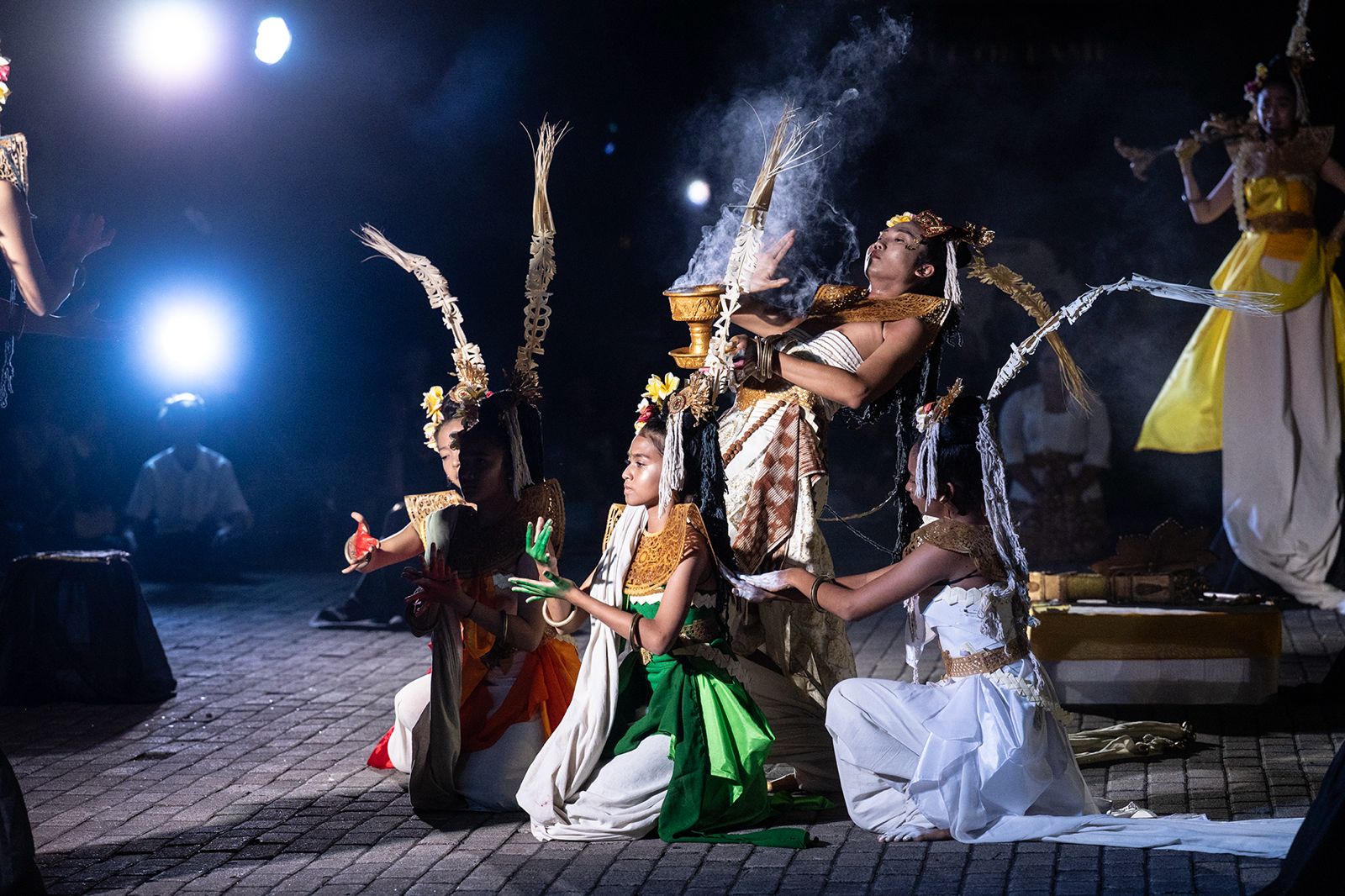
DENPASAR, balitourismnow.com – The movements are rhythmic and expressive, flowing naturally as if the dancers and music were speaking the same language. Every beat guides the choreography, while melody strengthens its emotional expression.
Yet beyond its visual beauty, Tari Pangider Bhuwana carries a deeper purpose: to make Balinese cultural and spiritual knowledge more accessible to Deaf communities through movement, visual symbols, sign language, and color.
Created by Putu Wahyu Putra Sudianta, a Master’s student in Arts at the Postgraduate Program of the Indonesian Institute of the Arts (ISI) Bali, Tari Pangider Bhuwana was presented as part of his thesis examination at the Widya Mahardika Field, ISI Bali, on Friday, July 24, 2026.
The work explores the philosophy of Dewata Nawa Sangha, the nine manifestations of divine forces associated with the nine cardinal directions in Balinese Hindu cosmology.
Rather than relying primarily on verbal explanation, Wahyu translates the concept into body language, sign language, visual symbols, spatial formations, costumes, colors, and interactive performance.
“I created Tari Pangider Bhuwana as a new dance work that conveys knowledge, philosophy, and the meaning of Dewata Nawa Sangha to Deaf friends in particular and to dance audiences in general. The performers also include Deaf children and students of ISI Bali,” said Wahyu.
From Personal Experience to Inclusive Art
The idea grew from Wahyu’s own experience as a Deaf person. He observed that many Deaf people participate in religious ceremonies without fully understanding the meanings behind the symbols and rituals they encounter.
“Based on my experience as a Deaf person, I see that many Deaf friends participate in religious ceremonies without fully understanding the meanings of the symbols used in Hindu rituals. The concepts of Pangider Bhuwana and Dewata Nawa Sangha, which embody the philosophy of cosmic balance in Balinese Hinduism, have not been fully conveyed because accessible learning media remain limited,” he explained.
A survey involving students from special-needs schools and Deaf communities further indicated that understanding of Dewata Nawa Sangha remains relatively limited. This encouraged Wahyu to develop dance as an alternative educational medium—one that communicates through visual and physical experience rather than spoken language.
The choreography is structured in five dramatic sections, tracing a journey from uncertainty toward spiritual understanding. The opening depicts confusion and anxiety caused by limited access to religious knowledge.
The second section introduces the nine manifestations of Dewata Nawa Sangha through nine dancers positioned according to the cardinal directions.
Iswara represents the east, Maheswara the southeast, Brahma the south, Rudra the southwest, Mahadewa the west, Sangkara the northwest, Wisnu the north, Sambhu the northeast, while Siwa occupies the center as a symbol of cosmic balance.
The third section draws inspiration from the Ngerebeg tradition, representing purification and harmony through circular movements, colorful flags, and mandala-like floor patterns.
The fourth section invites audiences to participate by identifying the positions of the deities and their symbolic weapons. The final section brings all dancers together once again, creating a visual representation of harmony between humanity, nature, and the divine.
Sign Language as an Artistic Language
One of the work’s distinctive artistic approaches is its synchronization of dance movement and Indonesian Sign Language (BISINDO). Wahyu develops what he describes as an “aesthetic of vibration,” in which aesthetic experience does not depend solely on sound but can also be experienced through movement, visual expression, rhythm, gesture, and bodily resonance.
Color psychology further strengthens the visual language. Each deity is represented through specific colors, costumes, lighting, floor patterns, and symbolic attributes, transforming the stage into a visual interpretation of Balinese Hindu cosmology.
The production involved artists from various disciplines, including eight dancers portraying Dewata Nawa Sangha, two gamelan musicians, 15 dancers in the Ngerebeg section, and a sign-language performer. Deaf communities, sign-language interpreters, and disability activists were also involved throughout the creative process.
Around 95 percent of the production team were Deaf people, working as dancers, crew members, and performers.
The spirit behind the work is captured in Wahyu’s thesis motto: “My eyes are my ears, my hands are my voice. As a Deaf person, I believe that limitations can become a source of strength to keep learning, creating, and opening paths for others.”
Breaking Barriers Through Art
Wahyu’s journey is significant beyond the stage. He is regarded as the first Deaf person to pursue an academic degree in arts creation at ISI Bali. His studies were not without challenges, particularly because learning support and accessibility for Deaf students remain limited.
During his Master’s program, Wahyu took the initiative to work with Indonesian Sign Language interpreter Stary Bosnan to support lectures and thesis supervision.
Academic literature also presented another challenge. Complex terminology and written references often required additional effort to understand. Wahyu therefore immersed himself deeply in the philosophy of Dewata Nawa Sangha before transforming it into choreography and visual language.
“I studied Dewata Nawa Sangha very deeply first. Once I truly understood it, I could explain the concept to the Deaf participants involved in the work, develop the choreography, and transform the ideas into a visual language that was easier to understand,” Wahyu said.
He also invited students from special-needs schools and Deaf communities across Bali to attend and participate in the performance through an educational game at the end of the presentation.
Through this approach, Tari Pangider Bhuwana becomes more than a dance performance. It becomes a space for cultural learning, participation, and inclusion.
At its heart, the work demonstrates that art can transcend the boundaries of sound and language. Movement becomes a voice, sign language becomes part of the artistic vocabulary, and the stage becomes a meeting place where knowledge can be seen, felt, and shared.
For Putu Wahyu, limitation is not the end of the journey. It is the starting point for discovering another way to listen, speak, create, and connect through art. [buda]