

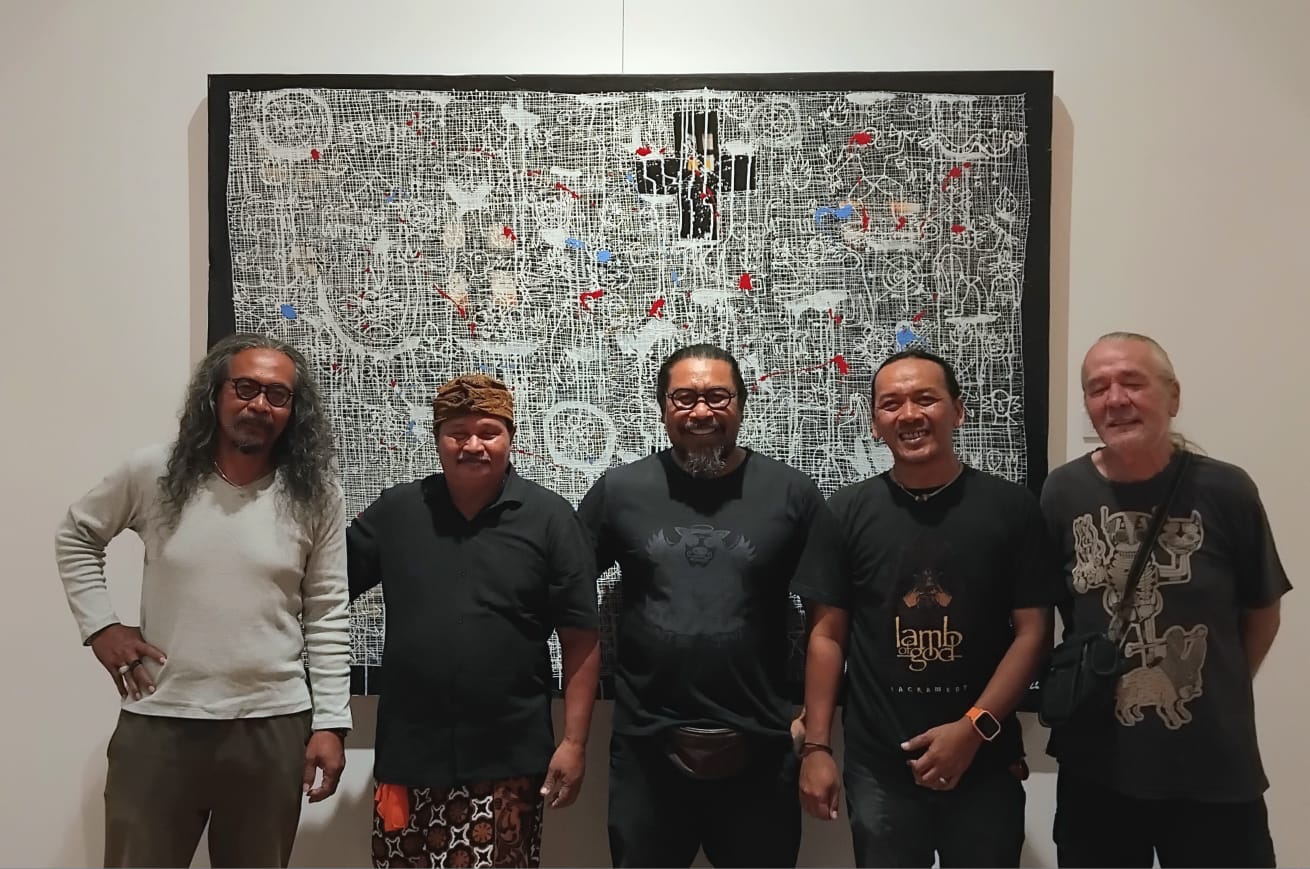
DENPASAR, balitourismnow.com – Balinese artist Made Wiradana reaffirms his artistic journey through his solo exhibition Kacatri, presented at Santrian Art Gallery in Sanur.
Officially opened by Prof. Dr. I Made Bandem on Friday, July 10, 2026, the exhibition marks a new chapter in Wiradana’s artistic practice, where spirituality is no longer merely a visual theme but has become the very foundation of his creative process.
Kacatri is Wiradana’s second solo exhibition at Santrian Art Gallery, seven years after his previous presentation.
During this period, his visual language has undergone a remarkable transformation, evolving alongside his personal journey as a Jero Mangku—a Balinese Hindu temple priest whose spiritual devotion has profoundly shaped his understanding of art, tradition, and life.
The term Kacatri refers to a spiritual calling inherited through one’s ancestral lineage. Within this exhibition, however, the concept extends beyond the transmission of tradition, representing an inner journey that leads an individual into a new phase of life.
This experience is translated into artworks filled with symbolic forms, expressive gestures, rich textures, and layered visual elements that invite viewers into a contemplative space.
According to Made Dolar Astawa, Curator and Gallery Manager of Santrian Art Gallery, Wiradana’s artistic development reveals a significant departure from his solo exhibition seven years ago.
While his earlier works explored primordial energies, the paintings in Kacatri demonstrate a deeper engagement with spirituality. His lived experience as a Jero Mangku has profoundly influenced the construction of his visual language.
This perspective is further explored in the curatorial essay by Made Susanta Dwitanaya, who interprets Wiradana’s creative journey as a liminal phase—a transitional space where the identity of the artist converges with his spiritual calling.
Rather than replacing his identity as an artist, his religious experience has given rise to a new visual language that is increasingly reflective, contemplative, and deeply rooted in lived experience.
Dwitanaya also observes that the works in Kacatri do not present spirituality through literal or illustrative narratives. Instead, each canvas becomes an experiential field that opens multiple possibilities for interpretation.
Ritual symbols, white linear forms reminiscent of sacred wastra textiles, rerajahan (sacred ritual diagrams), and spontaneous brushstrokes create layered meanings born from authentic spiritual practice.
Through this approach, Wiradana’s artistic practice emerges as a meeting point between contemporary art, Balinese cosmology, and spiritual devotion, each continuously enriching the other.
A graduate of the Indonesian Institute of the Arts (ISI) Yogyakarta, Made Wiradana has long been recognized as one of Bali’s prominent contemporary artists, with an exhibition record spanning numerous cities across Indonesia and abroad.
Beyond his artistic career, he continues to serve his community through the Balinese tradition of ngayah as a Jero Mangku while also performing the sacred Rangda dance, one of the most significant ritual dances within Balinese Hindu tradition.
These lived experiences now form the primary source of his artistic creation. Art is no longer positioned merely as a medium of representation but as an integral expression of spiritual practice itself.
Painting becomes an act of reflection, while each artwork functions as a site where personal experience, Balinese cosmology, and contemporary artistic discourse converge.
Through Kacatri, Made Wiradana demonstrates that artistic transformation arises not only from the exploration of technique and aesthetics, but also from a sustained inner journey.
The exhibition further illustrates how Balinese contemporary art continues to evolve through an ongoing dialogue between tradition, spirituality, and contemporary artistic practice.
Kacatri is on view at Santrian Art Gallery, Jalan Danau Tamblingan No. 47, Sanur, Denpasar, from July 10 through August 30, 2026. [I Gede Made Surya Darma]