

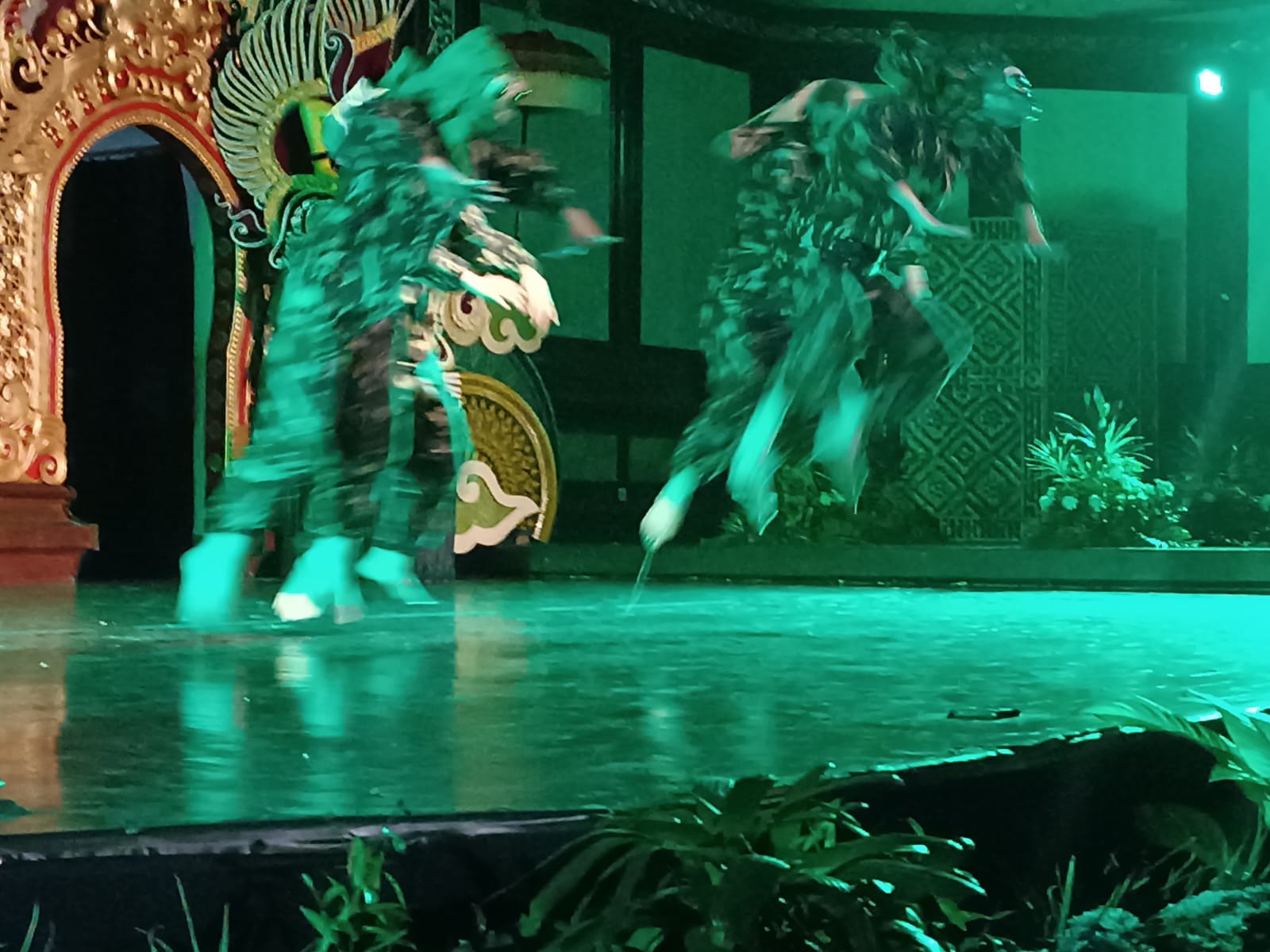
DENPASAR, balitourismnow.com – Thunderous applause echoed throughout Ksirarnawa Hall at the Bali Arts Center on Wednesday (July 8, 2026), as audiences at the 48th Bali Arts Festival (PKB XLVIII) witnessed an extraordinary cultural collaboration between Indonesia and South Korea.
The evening opened with Bayu Nada, a musical performance blending Bali’s vibrant gong kebyar ensemble with traditional Korean instruments. The concert then seamlessly transitioned into the dance drama Prince Frog (I Godogan), creating a captivating artistic journey that celebrated the meeting of two rich cultural traditions.
Presented through a collaboration between the Seoul Institute of the Arts and the Indonesia Institute of the Arts (ISI) Bali, the production was more than an artistic performance. It symbolized the growing cultural ties between Indonesia and South Korea while providing a platform for young artists from both countries to learn from one another and create together.
Dozens of dancers and musicians from both institutions brought the Balinese folktale I Godogan to life. Despite differences in musical traditions, costumes, and performance styles, the artists succeeded in creating a seamless and harmonious production.
One of the evening’s highlights came when Balinese and Korean performers shared the stage in a collaborative Kecak performance. The iconic rhythmic chants of Kecak were interwoven with traditional Korean melodies sung in the Korean language, resulting in a fresh interpretation that respected the identity of both cultures.
The accompanying blend of Balinese gamelan and Korean traditional music enriched every scene, giving the audience an immersive cultural experience.
The dance drama tells the story of I Godogan, who is actually Prince Jenggala, born under a curse in the form of a frog and raised by a humble farming family. Through a spiritual journey of purification and perseverance, he eventually regains his true human form.
The story reaches its climax when Godogan wishes to marry the Princess of the Daha Kingdom. Enraged by the proposal, the king orders Godogan’s father to be executed. Yet each time his father is killed, Godogan miraculously restores him to life. Witnessing these miracles, the king finally realizes that Godogan’s destiny has been ordained by the divine and grants his blessing for the marriage. At that moment, Godogan is transformed back into Prince Jenggala.
The performance concluded with a festive royal wedding featuring Kecak, Bali’s Barong Macan dance, and Korea’s Lion Dance. The energetic finale earned repeated standing ovations from the audience.
Earlier in the evening, Bayu Nada had already impressed spectators through the dynamic collaboration between Balinese gong kebyar musicians and Korean traditional instrumentalists, demonstrating how two distinct musical traditions can create a powerful artistic harmony.
Yoo Duk Hyung, founder of the Seoul Institute of the Arts, said he has developed a deep emotional connection with Bali after visiting the island several times.
“I truly love Bali, its people, and its arts. That is why I hope to build a long-term partnership between the Seoul Institute of the Arts and ISI Bali,” he said.
According to Yoo, Kecak is one of Bali’s most remarkable performing arts because it brings large groups of people together in perfect harmony.
“Kecak shows how people can unite in a single performance. It creates space for collaboration, harmony, and peace. Those are the values we hope to carry forward through this partnership,” he added.
The President of the Seoul Institute of the Arts, Chang Ji Hyung, described the collaboration as the beginning of many future artistic exchanges between the two institutions.
“We will continue pursuing the vision introduced by Mr. Yoo by exploring new forms of artistic collaboration. I am deeply impressed by what we have discovered in Bali, and I believe this partnership will continue to grow,” he said.
Meanwhile, renowned Balinese cultural scholar Prof. Dr. I Wayan Dibia explained that the creative process began through an academic exchange program in South Korea. Besides teaching Kecak, the ISI Bali team introduced Korean students to Balinese movement techniques, musical rhythms, and expressive performance styles.
According to Dibia, the choice of Godogan was closely aligned with this year’s Bali Arts Festival theme of spiritual purification, while also reflecting Korea’s strong tradition of folk storytelling.
“Art is one of the most effective ways to build relationships between nations. Through collaborations like this, people can experience how culture brings countries closer together,” he said.
The production involved 25 Korean artists and 15 students from ISI Bali, with creative workshops held both in South Korea and Bali.
“We hope young Balinese artists can learn from their Korean counterparts, just as Korean artists can learn from Bali’s rich artistic heritage. That is the true essence of this collaboration,” Dibia emphasized.
Prominent Balinese cultural figure Prof. I Made Bandem added that the participation of the Seoul Institute of the Arts in the 2026 Bali Arts Festival carries historical significance, recalling the cultural exchanges that have existed between Bali and South Korea’s Jeju Island since the 1990s.
“Their presence today not only strengthens cultural relations between our regions, but also reinforces Bali’s position as a global meeting point for arts and culture,” Bandem concluded. [buda]