

BALI, balitourismnow.com – The Indonesian Hotel General Manager Association (IHGMA) Bali Chapter expresses its concern over disruptions to fuel availability and distribution experienced by communities across Bali since 11 October 2026. Long queues at numerous fuel stations have not only disrupted public mobility but have also posed risks to the smooth operation of the tourism and hospitality industry, one of the main pillars of Bali’s economy.
Although queues reportedly began to ease gradually on 17–18 October following various response measures, IHGMA Bali believes that this incident should serve as an opportunity for a comprehensive review of supply preparedness, distribution effectiveness, public communication, and cross-sector crisis mitigation mechanisms.
As a professional association representing hotel General Managers, IHGMA Bali conducted an internal survey among its membership network to identify the impacts of fuel disruptions, mitigation measures implemented by hospitality businesses, and recommendations for policymakers.
The survey was conducted from 14 to 17 October 2026. The compiled report records 259 responses for each question presented. The survey findings were reviewed as input for discussions among IHGMA Bali’s leadership and advisory board to formulate the association’s official position, guided by the interests of the public, industry sustainability, and Bali’s reputation as an international tourism destination.
I.OBSERVATIONS BY IHGMA BALI
1.The gap between reported fuel stock availability and actual distribution conditions
On 12 October 2026, the Governor of Bali expressed optimism that fuel distribution issues could be resolved promptly following coordination with Pertamina. However, long queues and service disruptions at several fuel stations continued in the following days. On 13 October, Pertamina explained that supply had been delayed due to technical difficulties involving a tanker preparing to unload its cargo. On 14 October, the government and Pertamina reiterated that fuel stocks at Bali’s storage terminals remained sufficient.
Meanwhile, media reports on 14–15 October highlighted additional response measures, including the arrangement of phased shipments from Surabaya and the deployment of four fuel tanker trucks from Banyuwangi to Bali.
This situation demonstrates that sufficient stock at storage terminals does not necessarily translate into smooth distribution to fuel stations or actual availability for consumers. Going forward, public information should clearly distinguish between terminal stock volumes, incoming supply schedules, distribution capacity, and actual availability at individual fuel stations.
Accurate, consistent, and regularly updated information is essential to reducing uncertainty, panic buying, and public speculation.
2. Human resource readiness to support 24-hour fuel station operations
Extending fuel station operating hours is an important measure to improve public access to fuel. However, operating around the clock requires adequate staffing, shift arrangements, sufficient rest periods, occupational safety support, and effective mechanisms for managing queues and complaints.
Feedback from the field indicates that human resource readiness and work systems cannot always be expanded immediately. Physical and emotional pressure arising from extended working hours, combined with crowded queues, may create tension between fuel station attendants and the public.
IHGMA Bali believes that extended operating hours must be accompanied by adequate operational support. Smooth distribution should not depend solely on increasing staff working hours, but also on proper workforce planning, security support, and effective traffic management.
3. Crisis mitigation must be planned earlier and implemented in an integrated manner
Several measures, including work-from-home arrangements and online learning, odd-even vehicle restrictions, limits on fuel purchases, additional supplies, and the involvement of security personnel to support distribution, were implemented somewhat late, after queues had already spread.
IHGMA Bali recognizes that emergency policies require operational consideration and interagency coordination. Nevertheless, this incident highlights the importance of having mitigation protocols that can be activated progressively based on measurable indicators, such as increasing waiting times, declining fuel availability at stations, or disruptions to transport and logistics services.
Measures such as remote working, traffic management, purchase restrictions, and personnel deployment should be based on impact assessments, cross-sector coordination, and regular evaluation. This would enable emergency action to reduce pressure before disruptions develop into a broader crisis, rather than relying primarily on reactive responses.
4. More visible field leadership and inter-agency coordination are needed
When long queues and public anxiety increase, the direct presence of leaders and relevant officials on the ground is essential, not merely as a symbolic gesture of concern, but also to ensure that decisions are made promptly, appropriately, and in a coordinated manner.
IHGMA Bali appreciates the Governor of Bali’s direct presence among the public during this challenging situation. However, the response would be strengthened by the presence of other key stakeholders and relevant officials at multiple queue locations, ensuring that the burden of crisis management does not rest on one party alone and that problems can be addressed more quickly and comprehensively.
IHGMA Bali believes that crisis management requires clear divisions of roles and responsibilities among the regional government, Pertamina, security authorities, fuel station operators, and other relevant agencies. Their presence on the ground should focus on queue management, accelerating distribution, resolving operational bottlenecks, and communicating accurate and accountable information.
Effective coordination must also ensure that fuel station personnel receive adequate staffing, security, and operational support so that they can deliver services safely, orderly, and effectively during a crisis.
5. Public communication and digital information management must be strengthened
Fuel disruptions lasting several days, readily captured on mobile phones, quickly attracted attention across news outlets and social media, including international media. Reports of long queues, tourists losing valuable travel time, and disruptions to daily activities could affect perceptions of the convenience and comfort of travelling in Bali.
IHGMA Bali believes that crisis communication cannot rely solely on general statements about sufficient fuel stocks. Regional governments, Pertamina, and tourism stakeholders need to communicate practical information proactively, including which fuel stations are operating, current fuel availability, distribution arrangements, expected recovery timelines, and guidance for residents and visitors.
Tourism offices and industry associations should also be involved in disseminating information and mitigation guidance to hotels, travel agents, drivers, transport providers, and tourists. Timely and coordinated communication is necessary to limit the spread of unverified information, panic, and speculation.
6. Stronger enforcement against fuel hoarding and unreasonable resale prices
Crisis situations may be exploited by individuals who hoard fuel or resell it at unreasonable prices. Where such practices are identified, monitoring and law enforcement should be undertaken based on evidence and applicable regulations.
IHGMA Bali calls for accessible reporting channels, more effective distribution oversight, and transparent follow-up on suspected violations. These measures are important to protect public access to fuel, prevent consumer exploitation, and restore public confidence.
II. IMPACT ON THE TOURISM AND HOSPITALITY INDUSTRY
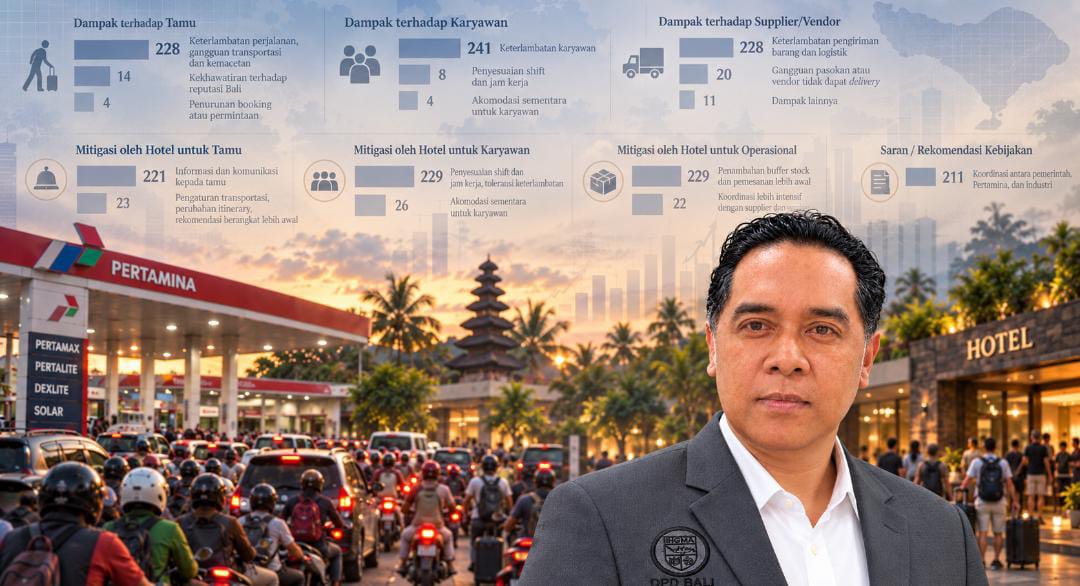
The IHGMA Bali internal survey identified three particularly significant operational impacts. First, disruptions to tourist mobility. A total of 228 responses reported travel delays, transport disruptions, and traffic congestion. These conditions may affect journeys to and from the airport, guest pick-up arrangements, visits to tourist destinations, and scheduled tourism activities.
Second, disruptions to workforce attendance. A total of 241 responses reported employee lateness. In the hospitality industry, which depends on shift systems and continuous service delivery, late arrivals can increase the workload of on-duty teams, disrupt shift handovers, and affect service speed and consistency.
Third, supply chain disruptions. A total of 228 responses reported delays in goods deliveries and logistics, while 20 responses indicated supply disruptions or vendors being unable to deliver. These conditions may affect the availability of food and beverages, linen, cleaning supplies, and other hotel operating essentials.
In addition, 215 responses under the category of other impacts indicated disruptions to internal operations and mobility. Fourteen responses expressed concerns about Bali’s image or reputation as a tourism destination, while four indicated the potential for declining bookings or demand.
These figures represent response frequencies from the internal survey and should not be interpreted as estimates of the proportion of all hotels in Bali affected. Nevertheless, the findings signal that fuel distribution disruptions can spread from transportation to workforce management, supply chains, guest experiences, and destination perceptions.
International coverage by media outlets including the Associated Press, Channel News Asia, the South China Morning Post, and Euronews on 14 October 2026 demonstrates that the incident also attracted attention overseas. For Bali as an international destination, effective communication and recovery are important to maintaining the confidence of tourists and travel partners.
III. STRENGTHENING PREVENTION AND MITIGATION AMONG IHGMA BALI MEMBER HOTELS
The IHGMA Bali internal survey shows that hotels and hospitality businesses implemented various adjustments to maintain service continuity.
1. Protecting guest experience and comfort
The most frequently reported mitigation measure was providing guests with updated information and communication, accounting for 221 responses. A further 23 responses cited transport arrangements, itinerary adjustments, and recommendations to depart earlier.
These measures help guests anticipate travel-time changes, adjust their schedules, and obtain clearer information about transportation services.
2. Maintaining workforce continuity
A total of 229 responses cited adjustments to shifts and working hours, along with tolerance for lateness, as key mitigation measures. Another 26 responses mentioned providing temporary accommodation or places for employees to stay overnight.
Flexible scheduling and support for employee needs are important to maintaining workforce readiness and ensuring service continuity.
3. Securing operational needs and supply chains
A total of 229 responses cited increasing buffer stock and placing orders earlier, while 22 responses emphasized closer coordination with suppliers and vendors.
These measures demonstrate the importance of inventory planning, supplier communication, and alternative sourcing arrangements to manage uncertainty in delivery schedules.
The findings indicate that hospitality businesses did not simply wait for conditions to return to normal; they also adapted their working processes to maintain service quality. However, individual hotels differ in their ability to implement mitigation measures depending on their scale, resources, and operational characteristics. Cross-sector support and coordination therefore remain essential.
IV. IHGMA BALI’S EXPECTATIONS AND RECOMMENDATIONS TO STAKEHOLDERS
Based on the internal survey and its assessment of the incident, IHGMA Bali puts forward the following recommendations.
1. Ensure adequate fuel supplies and reserves
The government and Pertamina should strengthen Bali’s fuel demand planning based on actual consumption, population mobility, tourism activity, transportation requirements, and logistics needs. Reserve mechanisms and alternative supply scenarios should be prepared to anticipate distribution delays.
2. Establish a transparent and accessible fuel information system
Official information on fuel availability, operating fuel stations, delivery schedules, and recovery measures should be updated regularly and disseminated through accessible digital channels. Information should distinguish terminal stock from actual availability at fuel stations so that the public can make decisions based on conditions on the ground.
3. Strengthen coordination among the government, Pertamina, and industry
A total of 211 responses emphasized the importance of coordination among the government, Pertamina, and industry. IHGMA Bali encourages the establishment of a crisis coordination mechanism involving regional authorities, fuel distribution operators, security agencies, tourism associations, transport operators, and hospitality industry representatives.
4. Develop crisis mitigation protocols that can be activated earlier
These protocols should specify activation indicators, responsibilities, public communication procedures, queue management, personnel support, and regular evaluation. Emergency policies should be implemented proportionately according to actual conditions and their potential impact on communities and economic activities.
5. Strengthen distribution oversight and law enforcement
Monitoring of suspected fuel hoarding, distribution abuse, and resale at unreasonable prices should be strengthened. Oversight processes should be transparent and supported by clear reporting channels and follow-up procedures.
6. Safeguard transportation, tourism, and logistics operations
During emergencies, the government should consider a measurable priority distribution mechanism for essential services, public transportation, healthcare and emergency services, food logistics, and tourism operations that directly affect visitor services. Such prioritization should be based on actual needs and must not undermine the public’s right to access fuel.
7. Establish integrated tourism crisis communication
The government and tourism stakeholders should establish an integrated crisis communication mechanism through regional government offices responsible for public relations, serving as PR links or communication liaison points.
This mechanism should act as a central coordination hub to ensure that accurate, consistent, timely, and integrated information reaches tourists, hotels, travel agents, airlines, and international partners. Through coordinated official communication channels, developments, response measures, and practical guidance can be shared promptly, reducing uncertainty, preventing conflicting information, and maintaining confidence in Bali as a tourism destination.
V. CLOSING STATEMENT
IHGMA Bali emphasizes that the fuel disruption in October 2026 was not merely an issue of energy availability. It was also a test of the readiness of distribution systems, institutional coordination, crisis communication, and the operational resilience of sectors that depend on mobility.
We appreciate the efforts undertaken by the government, Pertamina, security authorities, and businesses to accelerate service recovery. However, the easing of queues should not be a reason to discontinue the review process. Collective learning is necessary to ensure that similar disruptions can be anticipated earlier, managed in a coordinated manner, and prevented from developing into a crisis of public confidence.
As a professional association representing hotel leaders, IHGMA Bali stands ready to collaborate with the government and all stakeholders to strengthen crisis preparedness, maintain hospitality service continuity, and protect public interests and the sustainability of Bali’s tourism industry.
IHGMA Bali believes that Bali’s reputation as a world-class tourism destination must be supported by reliable, transparent, and resilient governance of infrastructure and essential supply distribution. [Chair of IHGMA Bali Chapter, Ratu Agung Bagus Ngurah Putra]