

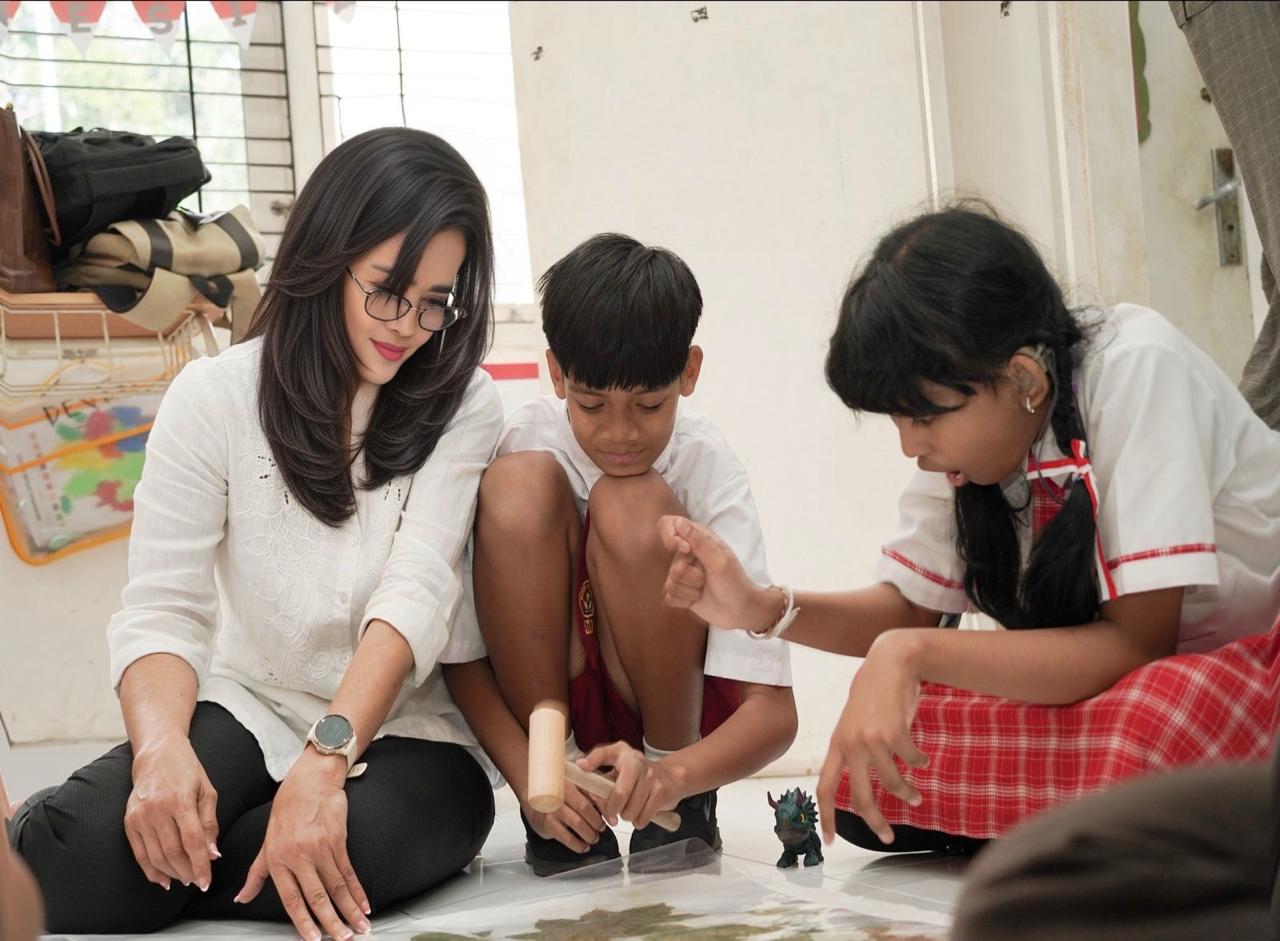
DENPASAR, balitourismnow.com – Education for Children with Special Needs (CSN) is currently undergoing a revolutionary turning point. Learning is no longer confined by physical or cognitive limitations but is increasingly shifting toward inclusive and adaptive educational environments that recognize and respect each child’s diverse potential.
Amid these developments, an innovative initiative has emerged from the classrooms of SLB Susrusa Denpasar and Yayasan Corti in Bali. Through the art of ecoprint, combined with the values of local Hindu wisdom, a new learning model known as ethno-peeragogy has been successfully tested to foster vocational independence while instilling noble character values.
This innovation, initiated by a multidisciplinary team of academics, addresses a longstanding challenge in special education: how to teach practical skills while simultaneously instilling moral values through concrete experiences rather than relying solely on verbal instruction and memorization.
The team behind this initiative consists of Dr. Putri Anggreni, S.E., M.Pd., from Universitas Hindu Indonesia, serving as Coordinator of Research and Hindu Curriculum Validation; Dr. Gede Yoga Kharisma Pradana, S.Sos., M.Si., from the International Institute of Tourism and Business, serving as Module and Field Development Specialist; and Prof. Dr. Ni Made Ruastiti, SST., M.Si., from the Indonesian Institute of the Arts (ISI) Bali, serving as Head of Arts, Culture, and Dissemination.
To date, studies on ecoprint have largely focused on aesthetics, creativity, or the development of vocational skills. Meanwhile, religious and character education for children with special needs has often been implemented separately through adapted methods that tend to be rigid.
The research team subsequently integrated ecoprint with the philosophy of Tri Hita Karana, a traditional Balinese concept of harmony encompassing the relationship between humans and God (Parahyangan), fellow human beings (Pawongan), and nature (Palemahan). This philosophy is deeply rooted in the everyday lives of the Balinese people.
“This program is based on a funding agreement for other service programs, specifically within the category of studies on objects for the advancement of culture and cultural heritage, as part of the 2025 program for utilizing the returns from the cultural endowment fund,” added Prof. Ruastiti.
The ecoprint-making process, from selecting leaves in the garden and arranging color compositions to pounding the fabric, waiting for the steaming process, and cleaning the equipment, offers an exceptionally rich pedagogical medium.
“Religious and character values cannot be adequately taught through lectures alone. Through ecoprint, children learn patience while waiting for the fabric to be steamed, discipline by following the sequence of activities, gratitude for the beauty of nature, and responsibility by putting the equipment back in order after use,” explained Prof. Ruastiti.
One of the most significant innovations of this model is the implementation of ethno-peeragogy, a process through which cultural and religious values are transmitted not only vertically from teachers to students but also horizontally through interactions among peers (peer learning).
In its practical implementation, the research team involved 20 students with special needs from SLB Susrusa and Yayasan Corti. Differences in motor and sensory abilities were not viewed as obstacles but rather as opportunities to foster complementary relationships and mutual support.
Children with stronger motor skills assisted their peers in arranging the leaves. Meanwhile, students with better communication skills took on roles in coordinating work turns. The classroom was transformed into a collaborative learning ecosystem where children learned to share materials, wait for their turns, and appreciate the diverse creations produced by their peers.
Under this research model, teachers transitioned into the role of facilitators. Meanwhile, children developed into active participants in the learning process, not merely as recipients of educational services but also as valuable sources of learning for one another.
The implementation of this adaptive learning model also involved close collaboration between educational institutions and cultural communities. The activities were centered at Yayasan Corti, located on Jalan Mahendradatta, Gang Puputan Baru A2, West Denpasar.
In total, the field activities involved 30 recorded participants and supporting parties, comprising 20 cultural practitioners, including children, adolescents, and adults with disabilities; one partner institution, namely Yayasan Corti; and eight technical support personnel, consisting of four teachers or special-needs assistants, two ecoprint facilitators, and two documentation officers.
In addition, the students’ parents were present to provide assistance and serve as the first audience to appreciate the children’s work during the limited-scale trial implementation.
“Through a tiered-task differentiation approach, this model demonstrates that children with various disabilities, whether sensory, cognitive, or physical, are still capable of producing aesthetically valuable fabric artworks while internalizing eight core character values: patience, perseverance, discipline, compassion, cleanliness, gratitude, cooperation, and respect for nature,” stated Prof. Ruastiti.
The successful implementation of the Tri Hita Karana-based ecoprint learning model in Denpasar offers fresh hope for the development of special education in Indonesia. The model positions ecoprint not merely as a finished product with commercial value but also as a medium for reflection and assessment of children’s behavioral development, independence, social awareness, and ecological consciousness.
“We hope that this adaptive ethno-peeragogy model can be replicated more widely across schools and regions, while enriching Indonesia’s cultural education landscape with an approach that embraces every child without exception. After all, woven into a piece of fabric adorned with natural leaf patterns is a vision of equality, harmony, and genuine independence,” concluded Prof. Ruastiti. [buda]